MetaHome recently joined a field delegation from Boreal Company in Phu Quoc to examine local marine conditions and explore the potential for seagrass restoration as part of broader efforts to protect the marine environment and coastal ecosystems.
The activity focused on direct observation of the marine area, including existing seagrass conditions and the practical environment in which potential restoration activities could be considered.
From Field Observation to Restoration Planning
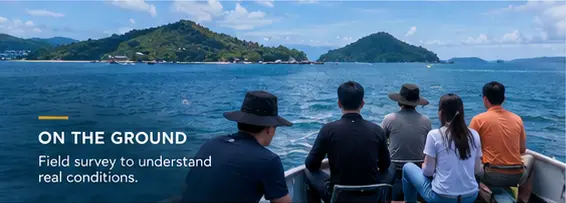
Restoring a marine ecosystem begins with understanding the ecosystem itself.
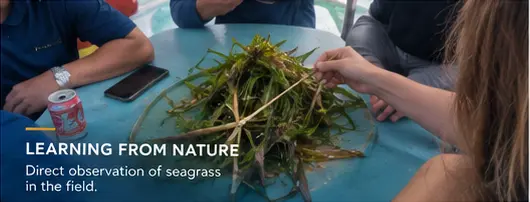
During the field survey, the delegation travelled by boat to observe the surrounding waters and examine seagrass specimens directly in the field.
The purpose was not simply to identify where seagrass exists,
but to gain a better understanding of the actual conditions that would need to be considered before any potential restoration or planting plan could be developed.
For marine restoration, factors such as site conditions, existing habitats, water characteristics, ecological suitability, local activities and long-term monitoring can all influence whether a restoration approach is appropriate.
For this reason, field observation represents an important early step before moving toward any potential implementation.
Why Seagrass Matters in Phu Quoc?
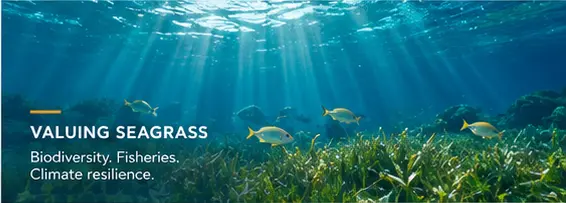
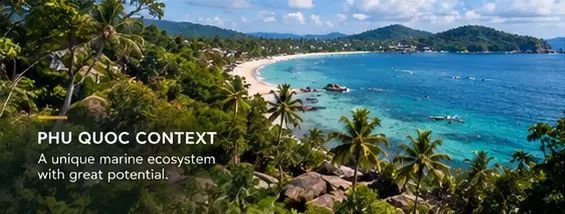
Phu Quoc has extensive marine habitats, including seagrass beds and coral reefs.
A study published in the Vietnam Journal of Marine Science and Technology in 2023, based on mapping and field verification of marine habitats, recorded more than 10,035 hectares of seagrass beds in the waters surrounding Phu Quoc in 2018. Approximately 9,185 hectares, or 91.52%, were located within the Phu Quoc Marine Protected Area.
The same study found that seagrass coverage declined by approximately 652 hectares, or 6.1%, between 2005 and 2018. The largest reported reduction occurred around Bai Vong, while other losses were recorded in several areas around Phu Quoc. The study associated the decline primarily with infrastructure development and dredging activities in certain locations.
The research also highlights the importance of seagrass beds to marine resources and fisheries in the area.
These findings provide useful context for understanding why marine habitat conservation and restoration deserve careful consideration in Phu Quoc. Importantly, these figures describe conditions identified through research up to 2018.
They should not be interpreted as a measurement of the current 2026 condition of Phu Quoc's seagrass ecosystem.
About Boreal Company
Boreal Company publicly positions its activities around ecosystem restoration, biodiversity, community engagement and carbon removals, with its current project focus centered on boreal forest restoration.
Its stated approach includes project identification, project design, stakeholder engagement, execution and long-term monitoring. The company's broader environmental restoration orientation provides relevant context for its interest in nature-based approaches.
For the Phu Quoc activity, however, the appropriate description at this stage is a field survey and exploration of potential seagrass restoration, rather than an announcement of an established marine restoration project.
MetaHome's Role
For MetaHome, the activity represents an opportunity to connect international environmental interests with local conditions and explore a potential restoration pathway in Vietnam.
The role at this stage is focused on field engagement, information exchange and supporting the exploration of what would be required for a potential future restoration initiative.
Rather than beginning with a predefined implementation model, the approach starts with the site itself: understanding the environment, identifying relevant conditions and considering what a practical restoration framework could look like.
Why This Matters?
Environmental projects increasingly require more than a single technical solution.
They require coordination between local conditions, scientific understanding, technology, stakeholders and long-term implementation capacity.
For Phu Quoc, protecting marine ecosystems is also closely connected with the island's broader economic and tourism environment.
The opportunity to explore seagrass restoration therefore represents a potential connection between environmental conservation and responsible development.
Next Steps
The parties will continue to exchange information and assess the conditions required for any potential next phase.
Further work would need to establish the ecological suitability, technical approach, relevant stakeholders and implementation requirements before any restoration program could be formally considered. .
At this stage, the activity should therefore be understood as an initial field survey and exploration of potential cooperation, not as an announcement of an officially implemented seagrass restoration project.
MetaHome Perspective
For MetaHome, sustainable development begins with understanding the real conditions on the ground.
Develop opportunity. Connect resources. Toward execution.
In environmental projects, responsible execution starts with the same principle: understand the ecosystem first, then design the intervention.