
Carbon is no longer only an environmental issue.
It is becoming an emerging economic ecosystem where
projects, data, technology, finance, verification and market access can all create value.
For investors and businesses, the important question is not simply
“How much is a carbon credit worth?”
The better question is:
Where is value created, and where can we participate in the value chain?
1. FIRST OF ALL, IT IS IMPORTANT TO UNDERSTAND ONE THING: CARBON IS NOT A UNIQUE COMMODITY
New people often say:
“I want to invest in carbon.”
But this is a way of speaking that is too broad.
In the carbon market, it is necessary to distinguish at least two important types of assets:
1. Emission quota
This is the amount of emissions allocated to facilities under the emissions management mechanism..
2. Carbon credit
This is the unit representing the amount of emission reductions or removals that meet the corresponding conditions and processes..
These two types have different origins, formation mechanisms, and methods of use.
Decree 29/2026/ND-CP has established a framework for the registration, custody, trading, and payment of eligible emission quotas and carbon credits on the domestic carbon exchange..
This is critical.
The carbon market not only creates opportunities for "selling credits." It also creates a whole system of services and finance surrounding carbon assets..
2. THE MARKET SIZE IS SHOWING ONE THING
Carbon pricing has gone beyond a mere environmental policy.
According to the World Bank, by 2026, direct carbon pricing mechanisms will cover nearly 30% of global greenhouse gas emissions, with 87 carbon pricing policies being implemented. Revenue from carbon pricing exceeded $107 billion in 2025..
Notably, the World Bank reported that the total amount of carbon credits issued increased by 8% in 2025, although credit prices generally decreased slightly and some types of high-quality credits still maintained higher prices..
This shows a principle:
The market is growing, but not all carbon credits are of equal value.
And that very difference creates business opportunities.
3. WHERE IS THE MONEY IN THE CARBON ECOSYSTEM?
It is possible to envision the carbon ecosystem as 8 layers of business opportunities:
| Layer | Activity | Opportunity |
| 01 | Underlying Project | Investment in emission reduction projects |
| 02 | Project Development | Development and structure of carbon projects |
| 03 | MRV & Data | Measurement, data, monitoring, verification |
| 04 | Technology | Emission reduction/elimination technology |
| 05 | Finance | Capital and carbon finance |
| 06 | Certification & Verification | Standards, assessment, verification |
| 07 | Trading & Market Access | Brokerage, transactions, connecting buyers |
| 08 | Corporate Decarbonization | Emission reduction solutions for businesses |
This is the perspective that investors should pay attention to.
4. Opportunity #1 — Invest in the underlying project
This is the most straightforward layer.
Potential projects include:
- Agriculture
- Forestry
- Renewable energy
- Waste management
- Recovery of methane gas
- Energy saving
- Clean technology
- Low-emission industrial production
The investor is not necessarily buying carbon credits.
Another approach is:
Investing in the project that generates carbon flow.
At that time, investors can simultaneously access:
Project cash flow + carbon value + other ancillary benefits.
This is often a more in-depth approach than merely speculating on credit prices..
5. But this is also where new investors make one of the biggest mistakes
A project being “green” does not automatically make it a good carbon project.
An experienced investor will not start by asking:
“How many credits can this project generate?”
The first questions are more fundamental:
Is the project real?
Can the emission reduction be measured?
Can it be demonstrated?
Is there an appropriate methodology?
Who owns the carbon rights?
What is the cost of generating each credit?
Who will buy the credits?
Why will they buy them?
This is the difference between:
Green Project
and
Investable Carbon Project.
6. Opportunity #2 — Project Development
One of the overlooked opportunities is:
You do not necessarily need to own every underlying asset.
A business can become a carbon project developer.
Potential projects include:
A company may own:
- A farm;
- A forest;
- A factory;
- A waste-treatment facility;
- An energy project;
But the owner may not have the capability to turn the activity into a structured carbon project.
A project developer can help move the project through a process such as:
Project screening → Feasibility → Carbon methodology → Project design → MRV → Registration → Verification → Issuance → Commercialization
The business model can include:
- Development fees;
- Consulting fees;
- Management fees;
- Revenue sharing;
- Economic interests in the project.
This is particularly relevant to Vietnam.
because the country has many potential underlying assets, while not every asset owner has the expertise to develop a bankable carbon project.
7. Opportunity #3 — Data may become more valuable than the credit itself
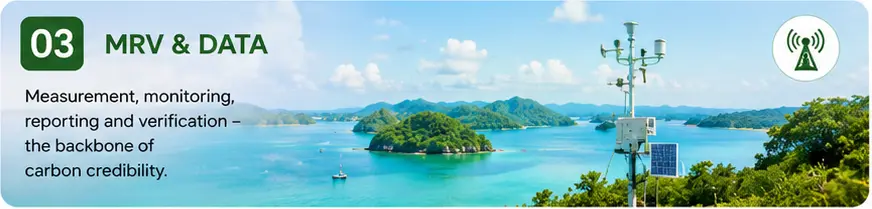
This is one of the most important points to understand.
Carbon is fundamentally a data-driven market.
Without reliable data: emission reductions are difficult to demonstrate.
Without credible evidence: carbon value becomes difficult to establish.
This creates opportunities around:
MRV — Measurement, Reporting & Verification
Including:
- Measurement;
- Data collection;
- Data management;
- Monitoring;
- Reporting;
- Verification;
- Traceability.
As Vietnam develops its carbon-market infrastructure,
carbon data is moving beyond being simply an environmental reporting requirement.
It is becoming part of the infrastructure behind a carbon asset.
8. Opportunity #4 — Emission-reduction technology
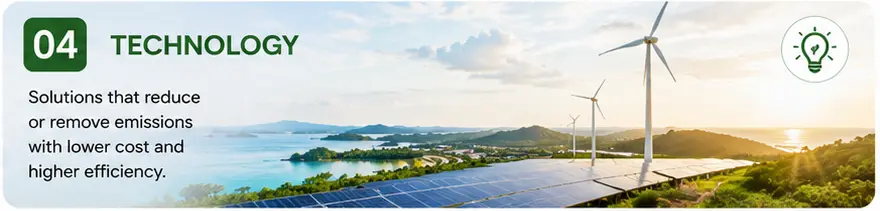
Carbon creates demand for technologies:
Tecnologies that can reduce emissions while improving economic performance.
Potential areas include:
- Energy efficiency;
- Renewable-energy potential ;
- Methane reduction;
- Waste treatment;
- Agricultural technology;
- Circular solutions;
- Low-carbon materials ;
- carbon removal.
But there is an important investment principle here.
Do not ask only:
“Can this technology generate carbon credits?”
A better question is:
“Does this technology make economic sense even when the carbon price is low?”
This distinction is critical.
If a project only becomes profitable when carbon prices rise significantly, its risk is higher.
If the project is economically viable before carbon revenue, carbon can become an additional upside.
That is generally a stronger investment structure.Đây là một nguyên tắc đầu tư rất quan trọng.
9. Opportunity #5 — Carbon finance
This may become one of the most important layers of the ecosystem.
A project may have:
Good assets
but
insufficient capital.
An investor may have: Capital but lack:
- Suitable projects;
- Carbon expertise;
- Project-development capability;
- Market access.
Carbon can therefore become part of a broader financing structure
Potential projects include:
Investor Capital
↓
Project
↓
Emission Reduction
↓
Carbon Credits
↓
Carbon Revenue
↓
Return to Investors
Potential structures may include:
- project finance;
- carbon pre-purchase;
- revenue sharing;
- blended finance;
- strategic investment;
- carbon-linked financing.
But one principle remains important:
Carbon revenue should not be treated as the only economic foundation of the project.
A strong project should have underlying economics beyond the carbon component.
10. Opportunity #6 — Verification, standards and carbon quality
As the market develops, the question is no longer simply:
“Does this project have carbon credits?”
The more important question becomes:
“How credible and valuable are these carbon credits?”
This creates demand for:
- validation;
- verification;
- standards;
- ratings;
- registry;
- traceability;
- carbon accounting, Quality assessment .
Two projects may each generate: 100,000 carbon credits but their market value may be very different.
The difference can come from:
Transparency;
Additionality;
Data quality;
Verification;
Permanence;
Environmental impact;
Social impact;
Market eligibility.
Therefore:
Carbon quality can become an asset in itself.
11. Opportunity #7 — Trading and market access

Once there is:
Seller
and
Buyer
another layer of the ecosystem emerges. Businesses can create value through:
- Brokerage;
- Market intelligence;
- Price discovery;
- Buyer–seller connections;
- Trading;
- settlement;
- Transaction support ;
- Portfolio management.
Vietnam's developing domestic carbon-market infrastructure is important in this context.
The creation of mechanisms for registration, ownership transfer, custody, trading and settlement means carbon is gradually moving toward becoming a more structured market asset.
The key point is:
Carbon is moving from a policy concept toward an economic asset with market infrastructure around it.
12. Opportunity #8 — Corporate decarbonization
A company does not need to own a forest
or renewable-energy project to participate in the carbon economy.
It can participate by providing:
Carbon advisory
ESG / decarbonization services
GHG accounting
MRV software
Carbon procurement
Carbon trading
Supply-chain decarbonization
Technology
Finance
Legal
Due diligence
This is important because: (They can instead build businesses around helping other companies reduce, measure, manage or use carbon value).
The carbon market creates opportunities for companies that do not directly generate carbon credits.
13. Where is Vietnam in this transition?
This is a particularly important part for investors.
Vietnam is no longer just at the "market research" stage”.
The legal framework is transitioning to the stage of practical operation.
Decree 119/2025/ND-CP stipulates a roadmap until the end of 2028 focusing on the national registration system, piloting a carbon trading platform, and mechanisms for trading and offsetting credits; from 2029, it will transition to deeper development steps, including a quota auction mechanism..
In the year 2026:
- The total pilot quota for the year 2025 is 243.1 million tCO₂e.
- The year 2026 is 268.4 million tCO₂e.
- The pilot phase focuses on thermal power plants, steel, and cement facilities.
- Decision 699/QĐ-BNNMT applies allocation to 110 facilities in these groups.
This is a very significant transition.
The carbon market is starting to create real demand from emitting companies..
14. But a larger market does not mean every project will make money
This is perhaps the most important lesson for investors.
There can be:
Strong demand
but
Weak project economics.
There can be:
carbon credits
but
No suitable buyer.
There can be:
High carbon prices
but
Even higher project-development costs.
There can be:
A green project
but
No eligibility to generate tradable carbon credits.
Therefore:
A growing carbon market does not automatically make every carbon project a good investment.
15. The principles experienced investors use
Instead of asking:
❌ “How many credits can this project generate?”
Ask:
✅ “How much economic value does each credit actually create?”
Instead of:
❌ “What is today's carbon price?”
Ask:
✅ “Can the project survive under a low-carbon-price scenario?”
Instead of:
❌ “Is this project green?”
Ask:
✅“Is carbon actually part of the business model, or is it only a marketing story?”
Instead of:
❌ “If there are carbon credits, they can be sold.”
Ask:
✅ “Who is the ultimate buyer, and why do they need these credits?”
Instead of:
❌ “The project can generate one million credits.”
Ask:
✅ “Are those one million credits sufficiently credible, legally usable and commercially marketable?”
16. A simple framework for evaluating a carbon business
Có thể sử dụng một mô hình rất đơn giản:
CARBON BUSINESS VALUE
Project
× Carbon Potential
× Credit Quality
× Market Access
× Price
− Development Cost
− Transaction Cost
− Regulatory Risk
= Potential Economic Value
This is not an accounting formula.
It is an investment framework.
It helps investors avoid a common mistake:
Looking at the volume of carbon before looking at the economics behind it.
17. The biggest opportunity may not be the carbon credit

If we look at the entire value chain, one point becomes clear:
The carbon credit is only the final product of a much larger system.
Value can be created at every layer:
ASSETS
Land, forests, factories, agriculture, energy and waste.
↓
PROJECTS
Designing activities that reduce emissions.
↓
DATA
Measuring and proving the results.
↓
CARBON
Creating and verifying carbon credits
↓
FINANCE
Providing capital to the project.
↓
MARKET
Finding qualified buyers.
↓
TRANSACTION
Transferring and settling the asset.
↓
CORPORATE USE
Using carbon within corporate decarbonization strategies.
Every layer can support a business model.
18. Vietnam has a particularly interesting advantage
Vietnam combines:
- A large manufacturing economy ;
- Significant agricultural activity;
- Extensive forest resources;
- A long coastline ;
- Renewable-energy potential ;
- Industrial development;
- Logistics;
- Urbanization ;
- The demand for technology transfer;
- Export-oriented businesses .
This creates a major strategic question:
How can the transition toward a lower-carbon economy become a new source of assets and cash flow?
For example, an agricultural project that reduces emissions may create:
Lower production costs + higher efficiency + improved product quality + carbon value.
An industrial project may create:
Energy savings + lower operating costs + lower emissions + stronger competitiveness in international supply chains.
This is the concept of: Carbon as an additional value layer.
19. The strongest opportunities may sit at the intersection of industries
One of the less obvious aspects of the carbon economy is that:
Carbon is not a standalone industry.
It intersects with:
Real Estate
Infrastructure
Energy
Agriculture
Forestry
Industrial Manufacturing
Waste
Technology
Finance
Logistics
Export
Data
Therefore, an investor with experience in a traditional industry does not necessarily need to “move into carbon”.
A more strategic approach can be:
Integrate carbon into an existing business model.
This may provide a more practical path than building a carbon business from zero.
20. So, where is the money?
If the entire ecosystem is reduced to one principle:
The money is not only in carbon credits. The money is in turning a real emission-reduction activity into an asset that can be measured, verified, financed and commercialized.
The opportunities therefore include:
01 — OWN THE PROJECT
Invest in assets that generate carbon value.
02 — DEVELOP THE PROJECT
Turn real assets into structured carbon projects.
03 — BUILD THE DATA
Create MRV and carbon-data infrastructure.ata.
04 — PROVIDE THE TECHNOLOGY
Help businesses reduce emissions more efficiently.
05 — PROVIDE THE FINANCE
Fund the transition and participate in the resulting value.
06 — BUILD TRUST
Support verification, standards and carbon quality.
07 — CONNECT THE MARKET
Connect credible supply with real demand.
08 — SERVE CORPORATES
Help companies measure, reduce and manage emissions.
21. The final perspective for investors
The carbon market is still developing.
That means:
Higher uncertainty than a mature market.
But it also means:
More gaps in the value chain.
The most attractive opportunities may not necessarily be where everyone is looking.
It may not simply be:
“Buy carbon credits.”
It may be:
Build the infrastructure that allows carbon credits to be created, measured, verified, financed, traded and used.
This is where carbon can move from an environmental concept into a business ecosystem.
For investors, the most important question is therefore not:
“Can carbon make money?”
It is:
“Which part of the carbon ecosystem can I create value in — and where is my competitive advantage?”
That is the starting point of a long-term carbon business model.
METAHOME INSIGHT
THE REAL OPPORTUNITY IS NOT CARBON.
IT IS THE VALUE CHAIN AROUND CARBON.
In the emerging market phase, the advantage may belong to those who enter the right link early, rather than just chasing the final asset.
For investors, the question worth asking is not:
“Can Carbon make money??”
A better question is:
“Which link in the carbon ecosystem can I create value at — and where does my advantage lie??”
That is just the starting point of a carbon business model with long-term growth potential..
This article is intended for general market and investment analysis only. It does not constitute investment, financial or legal advice. The ability to generate, register, trade or commercialize carbon credits depends on the project type, applicable mechanism, standards, regulations and market conditions at the relevant time.