
Carbon can create real economic value. But having a “green” project does not automatically mean having a valuable carbon asset.
The global carbon market is expanding rapidly. According to the World Bank, by 2026, 87 carbon pricing policies will have been implemented globally, covering more than 29% of global greenhouse gas emissions. The average carbon price of direct pricing instruments has risen to nearly $21/tCO₂e..
But that does not mean:
There is a green project → there are carbon credits → there is money.
Yet there is still a significant gap between: “A project that benefits the environment” and “a project that can generate tradable carbon credits and sustainable returns.” là rất lớn.
For investors, understanding this gap is critical.
1. THE PROJECT MUST CREATE REAL CARBON VALUE
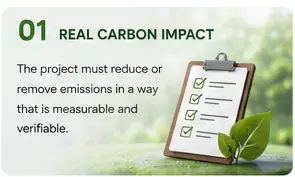
A project may be environmentally beneficial without necessarily generating carbon credits.
For example:
A business investing in energy-saving systems.
Businesses are actually reducing electricity consumption — but to turn that result into carbon credits, proof is needed:
How much would the project have emitted without the investment?
How much does it emit after implementation?
Can the reduction be measured? Can it be independently verified?
If these questions cannot be answered, the carbon value becomes difficult to establish.
2. THE REDUCTION MUST BE MORE THAN “BUSINESS AS USUAL”
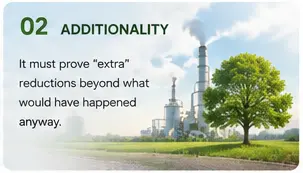
One of the key questions is .
whether the emission reduction would have happened without the carbon project
A carbon project must demonstrate that its climate impact is real and additional.
In simple terms:
Not every emission reduction can automatically become a carbon credit.
The reduction must follow an appropriate methodology and be assessed through the applicable verification process.
3. DATA IS CRITICAL
Carbon is fundamentally a data-driven market..
A credible project needs reliable information showing:
- How much was emitted?
- How much was reduced?
- How the reduction was achieved?
- When it occurred?
- How the data was collected?
- How the results were verifiedAi kiểm tra?
Weak or incomplete data can make an otherwise promising project difficult to commercialize.
This is why MRV — Measurement, Reporting and Verification — is becoming increasingly important as Vietnam develops its carbon market infrastructure.
4. DEVELOPMENT COSTS CAN REDUCE THE ECONOMICS
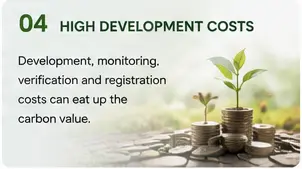
This is one of the issues investors often overlook.
A project may generate:
100.000 carbon credits
But that does not mean:
100,000 × selling price = profit.
Before revenue is generated, the project may incur costs for:
🌱 Project Development
→ Data
→ Monitoring
→ Consulting
→ Verification
→ Registration
→ Management
→ Commercialization
→ Trading
If the project is too small, these costs can become significant on a per-credit basis.
Large carbon volume does not automatically mean strong carbon economics.
5. TIME MATTERS
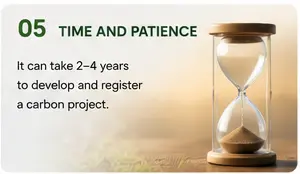
Carbon is generally not a: “Develop today — sell tomorrow” investment.
Depending on the project and mechanism, developing, registering and verifying a carbon project can take several years.
This creates an important investment consideration:
Investors need the ability to wait for environmental results to become commercial value.
Carbon therefore tends to fit better with a long-term project investment mindset than with short-term speculation.
6. SCALE MATTERS
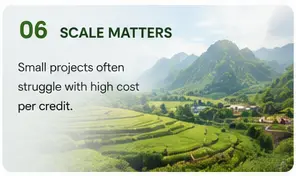
A small project can generate carbon.
But the real question is:
Is it large enough to justify the investment?
Consider two projects:
Project A
2,000 credits per year
Project B
500,000 credits per year
If development, monitoring and verification costs are relatively similar, Project B has a significant advantage through economies of scale.
This is why aggregating smaller projects, standardizing data and developing large-scale programs can create an attractive business model.
7. HAVING CARBON DOES NOT MEAN HAVING A BUYER
This is critical:
.Đây là một điểm rất quan trọng:
Generating carbon credits does not guarantee that they can be sold at an attractive price.
The market is increasingly differentiating between different types and qualities of carbon credits.
The World Bank noted in 2025 that the supply of carbon credits continues to exceed demand, while high-quality credits or those that can be used in certain compliance markets still command better prices..
A carbon project should be designed with the market in mind — not only after the credits have been generated. Investors therefore need to ask:
Who will buy them?
Why will they buy them?
Which market will accept them?
Which standard is required?
What makes these credits valuable?
8. ĐIỂM NGHẼN: CHẤT LƯỢNG CARBON
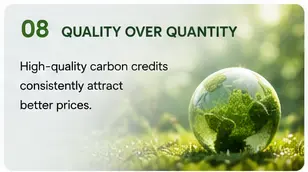
The carbon market is increasingly distinguishing between:
Carbon volume
and
Carbon quality.
Two projects may each generate:
100.000 credits
but their economic value may be very different.
Buyers may consider:
- Transparency
- Additionality
- Data quality
- Verification
- Permanence
- Environmental impact
- Social impact
- Market eligibility
This leads to an important investment principle: The objective should not simply be to maximize the number of credits. It should be to create credible, usable and marketable carbon assets.
Therefore:
Carbon quality can matter more than carbon quantity.
9. CARBON RIGHTS MUST BE CLEAR
This becomes particularly important
when investing in projects involving:
Land
Forests
Farmers
Companies
Technology
Investors
Carbon developers
The critical question is:
Who has the right to the carbon value?
If ownership, benefit-sharing and contractual rights are unclear from the beginning, the project may face disputes or delays later.
Therefore, carbon rights should be part of investment due diligence from day one.
10. THE REGULATORY FRAMEWORK IS STILL DEVELOPING
Vietnam is rapidly building the infrastructure for its domestic carbon market.
In 2026, Vietnam has:
- Approval of the total pilot emission quota of 243.1 million tCO₂e for the year 2025 and 268.4 million tCO₂e for the year 2026.
- Allocation of pilot quotas for 110 facilities in the thermal power, cement, and steel industries.
- Issuance of Decree 29/2026/ND-CP on the domestic carbon exchange.
- Continue to improve the National Registration System and the market operation mechanism.
This creates opportunity
but also requires investors to remain closely informed.
In carbon, regulatory awareness is part of investment risk management.
11. SO, WHAT MAKES A CARBON PROJECT INVESTABLE?
A project should not be considered attractive simply because it is “green”.
It should ideally demonstrate:
REAL PROJECT
A genuine, operating project.
REAL REDUCTION
Real emission reduction or carbon removal.
MEASURABLE
Results that can be measured.
VERIFIABLE
Results that can be independently verified.
LEGAL
Clear legal structure and carbon rights.
SCALABLE
Potential to expand.
MARKETABLE
Access to suitable buyers and markets.
ECONOMIC
A viable financial model after all costs.
12. THINK ABOUT CARBON AS AN INVESTMENT
Instead of asking:
“How many carbon credits can this project generate?”
Investors should ask:
1. PROJECT
Is the underlying project viable?
2. CARBON
How much credible carbon can it generate?
3. COST
What does it cost to create each credit?
4. MARKET
Who will buy the credits, and where?
5. PRICE
Is the expected price commercially attractive?
6. RIGHTS
Who owns and benefits from the carbon value?
7. TIME
How long before the project generates cash flow?
This is the difference between:
“A green project”
and
“An investable carbon project.”
FROM ENVIRONMENTAL VALUE TO ECONOMIC VALUE
The carbon market is expanding, but not every emission-reduction project will become a valuable carbon asset. .
The real challenge lies in moving from:
Idea → Real Project → Data → Carbon Credit → Market → Revenue
At every stage, value can be lost. For investors,
the opportunity is therefore not simply to find a project that sounds green.
The opportunity is to identify projects with:
REAL PROJECT + REAL CARBON + CLEAR RIGHTS + RELIABLE DATA + MARKET ACCESS + POSITIVE ECONOMICS
When these elements come together, carbon can move from environmental value to economic value.
METAHOME INSIGHT
Do not invest in carbon volume alone.
Invest in the quality of the project behind it.
This article provides general investment-oriented information and does not constitute investment or legal advice. The ability to generate, register, trade and commercialize carbon credits depends on the project type, applicable mechanism, standards, regulations and market conditions at the relevant time.
