
Understanding Vietnam’s carbon market from an investor’s perspective
Vietnam’s carbon market is moving from policy development toward practical market operation.
Several important regulatory milestones have emerged: Decree No. 06/2022/ND-CP, as amended by Decree No. 119/2025/ND-CP and Decree No. 83/2026/ND-CP; Decree No. 29/2026/ND-CP on the domestic carbon exchange; and Circular No. 11/2026/TT-BNNMT on the National Registration System.
For investors, the key questions are simple:
Who can participate? What can they do? And what does a project need to qualify for the carbon market?
1. WHO CAN PARTICIPATE?
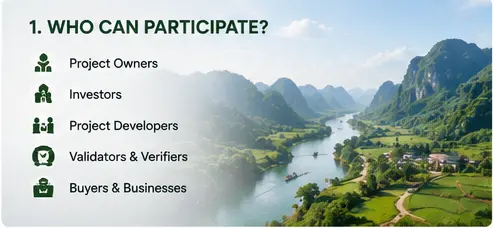
The carbon market is not limited to environmental companies.
It involves several participants.
PROJECT OWNERS
Organizations or businesses with real projects capable of reducing or removing greenhouse gas emissions.
For example:
- Agriculture
- Forestry
- Renewable energy
- Waste management
- Industry
- Clean technology
This is where the initial carbon value is created.
INVESTORS
Investors can participate through:
Capital + Technology + Project development + Strategic partnerships
An investor does not necessarily need to create carbon credits directly.
The opportunity can be to invest in projects that generate carbon value, with economic rights determined by the project structure and contractual arrangements.
PROJECT DEVELOPERS
Project developers help turn a real project into a structured carbon project:
They can support:
Project identification → Structuring → Methodology → Monitoring → Verification → Registration → Carbon development → Market access
For investors, this is a critical link because a good project can still fail to generate investable carbon value if it is poorly structured.
VALIDATION / VERIFICATION BODIES
Carbon value cannot simply be based on a project owner's declaration.
Emission reductions or removals need to be measured, assessed and verified under the applicable mechanism.
The current legal framework also stipulates the role of the appraisal units in the process of registration and credit issuance for the domestic mechanism.
BUYERS / COMPANIES WITH CARBON NEEDS
Companies may participate because they need carbon instruments for compliance, emissions management or broader sustainability objectives.
Vietnam's domestic carbon market is being developed around two important instruments:
Greenhouse gas emission allowances
and
Carbon credits.
Decree 29/2026/ND-CP has established a framework for the registration, custody, trading, and payment of eligible goods on the domestic carbon exchange..
2. WHAT CAN A PROJECT OWNER DO?
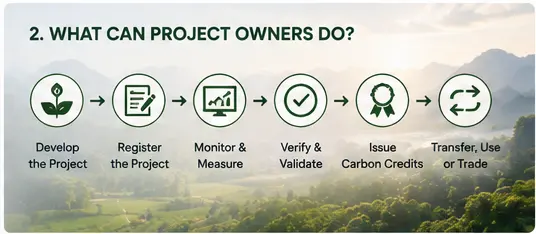
In principle, an eligible project can move through a process such as:
🌱 Project Development
→ Develop the project
→ Register under the applicable mechanism
→ Monitor and measure results
→ Credit issuance, if requirements are met
→ Registration
→ Transfer, use or trade according to applicable rules
The exact requirements depend on the type of project and the carbon mechanism being used.
3. NOT EVERY EMISSION-REDUCTION PROJECT CREATES CARBON CREDITS
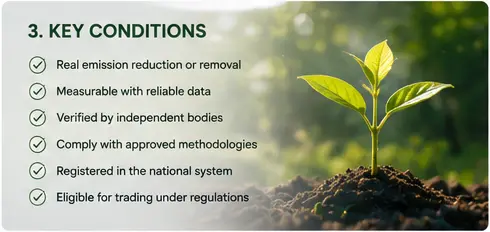
This is one of the most important points for investors.
A project can be environmentally beneficial without automatically generating tradable carbon credits.
A credible carbon project generally needs:
A REAL PROJECT
It must be an actual activity — not simply an idea.
MEASURABLE EMISSION REDUCTIONS OR REMOVALS
The environmental result must have a reasonable basis for quantification.
AN APPROPRIATE METHODOLOGY
The calculation needs to follow the methodology applicable to the relevant carbon mechanism.
RELIABLE DATA
Without credible data, the claimed carbon result is difficult to demonstrate.
MONITORING AND VERIFICATION
The reported results must meet the applicable verification requirements.
REGISTRATION
Eligible carbon credits need to be properly recorded within the relevant registration system before transactions can be conducted under the applicable rules.
4. SO, WHAT CAN INVESTORS ACTUALLY DO?
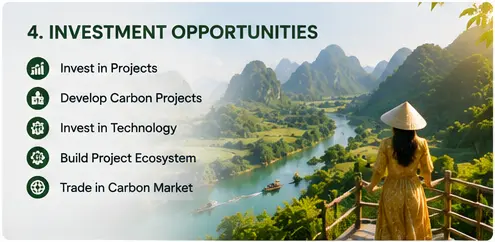
This is the most important part.
This is where the investment opportunity becomes more interesting.
01 — INVEST IN PROJECTS
Provide capital to projects with genuine carbon-generation potential.
02 — INVEST IN PROJECT DEVELOPMENT
Participate from the early stage, when the carbon structure is being designed.
03 — INVEST IN TECHNOLOGY
Provide technologies that help projects reduce emissions or increase carbon removal.
04 — BUILD THE PROJECT ECOSYSTEM
Connect: Landowners + Businesses + Technology + Capital + Experts + Markets
05 — PARTICIPATE IN THE CARBON MARKET
Buy, sell or trade eligible carbon instruments in accordance with applicable regulations. The opportunity is therefore not limited to simply buying carbon credits.
Decree 29/2026/ND-CP has now established a direct legal framework for the domestic carbon exchange.
5. WHO OWNS THE CARBON VALUE?
For investors, this question is extremely important. The question is not only:
“How many carbon credits can this project generate?”
It is also:
“Who has the rights to the carbon value created by the project?”
This should be clearly addressed in the project structure and contracts between relevant parties, such as:
Project owner
Investor
Project developer
Land, forest or asset owner
Technology provider
Commercialization partner
If these rights are not clearly established from the beginning, a project may generate carbon credits while the economic rights among the parties remain unclear.
For an investor, this should be part of the initial due diligence.
6. WHERE IS VIETNAM TODAY?
Vietnam is moving beyond simply discussing carbon-market policy.
On January 19, 2026, the government issued Decree 29/2026/ND-CP on the domestic carbon exchange..
On February 13, 2026, the Ministry of Agriculture and Environment issued Circular 11/2026/TT-BNNMT, regulating the management and operation of the National Registration System for greenhouse gas emission quotas and carbon credits; the document takes effect from March 30, 2026..
Notably, during the pilot phase of 2025–2026, Vietnam has allocated emission quotas for 110 facilities in the thermal power, cement, and steel industries. The total approved quota is 243.1 million tons of CO₂ equivalent for the year 2025 and 268.4 million tons for the year 2026..
By June 29, 2026, Vietnam announced the launch of its domestic carbon exchange..
This represents an important transition::
Vietnam's carbon market is moving from a policy framework toward market infrastructure.
7. WHERE ARE THE INVESTMENT OPPORTUNITIES?
As the legal framework becomes clearer, opportunities lie not only in purchasing carbon credits.
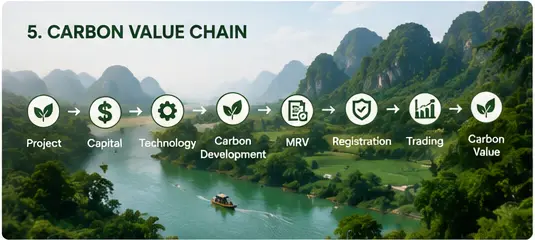
A new value chain is emerging:
PROJECT → CAPITAL → TECHNOLOGY → CARBON DEVELOPMENT → MRV / VERIFICATION → REGISTRATION → TRADING → CARBON VALUE
This opens up opportunities for various groups of investors and businesses to participate in different roles..
8. A LEGAL FRAMEWORK DOES NOT MEAN EVERY PROJECT QUALIFIES
This distinction is critical.
Having a legal framework does not mean:
“Every green project can automatically generate carbon credits.”
A project still needs to address issues such as:
Project legality
Rights and responsibilities of the parties
Carbon methodology
Monitoring and measurement, Data quality
Verification
Registration
Trading requirements
Domestic regulations
International requirements, where applicable
Projects involving international transfer of carbon outcomes may face additional requirements.
9. THE INVESTOR'S VIEW
A carbon project should not be evaluated only by asking:
“How many credits can it generate?”
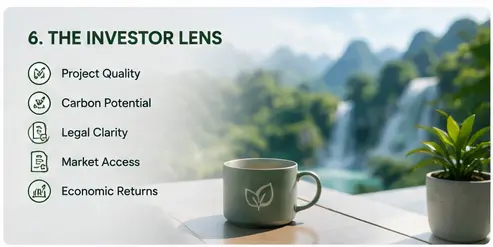
A better investment framework is built around five questions:
01 — PROJECT
What is the real project?
02 — CARBON
How can the project generate measurable carbon value?
03 — LEGAL
Who owns the relevant project and carbon rights?
04 — MARKET
Where can the resulting carbon instruments be used or traded?
05 — ECONOMICS
After development, monitoring, verification and commercialization costs, how much economic value remains?
This is how carbon should be viewed from an investment perspective, rather than simply as an environmental concept.
CONCLUSION
Vietnam's carbon-market framework is becoming increasingly structured.
The direction is clear: Regulation → Registration → Market Infrastructure → Trading → Investment Opportunities.
For investors, the objective should not be to simply chase carbon credits.
The real opportunity is to identify:
A REAL PROJECT + CLEAR RIGHTS + SOUND LEGAL STRUCTURE + RELIABLE DATA + MARKET ACCESS + ECONOMIC VALUE
When these elements come together, carbon can become a genuine economic asset within a real-world project.
METAHOME INSIGHT
Understand the rules. Structure the project. Identify the opportunity.
This article provides a general investor-oriented overview and does not constitute legal, financial or investment advice. Specific requirements depend on the project type, applicable carbon mechanism, project rights, methodology and regulations in force at the time of implementation.