
From an emerging market to a new investment opportunity
If the global carbon market is moving from climate commitments toward economic value, Vietnam is at an important stage.
Vietnam is no longer at the idea stage — but the market is not yet mature.
The country is now moving through market development, regulatory formation, pilot programs and the development of projects capable of creating measurable carbon value.
For investors, this early stage is worth watching.
1. VIETNAM ALREADY HAS REAL CARBON ASSETS
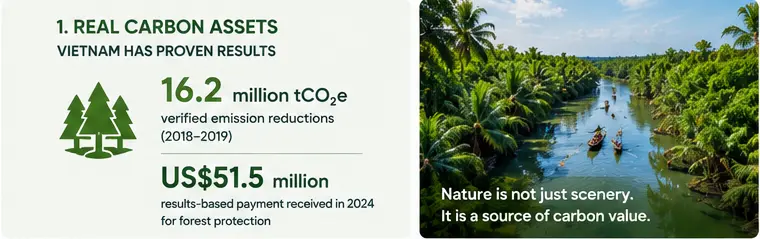
Carbon in Vietnam is no longer only a policy concept.
One important example is Vietnam's forest emissions-reduction program with the World Bank.
In 2024, Vietnam received US$51.5 million from the Forest Carbon Partnership Facility (FCPF) for verified emissions reductions.
The program generated 16.2 million tonnes of verified emissions reductions during 2018–2019, exceeding the original target of 10.3 million tonnes.
This is an important signal:
Vietnam's natural resources can generate measurable emissions-reduction results with financial value.
More importantly, Vietnam has gained practical experience in measuring, verifying and receiving payments based on verified emissions-reduction results.
2. VIETNAM IS MOVING FROM PROJECTS TO A MARKET
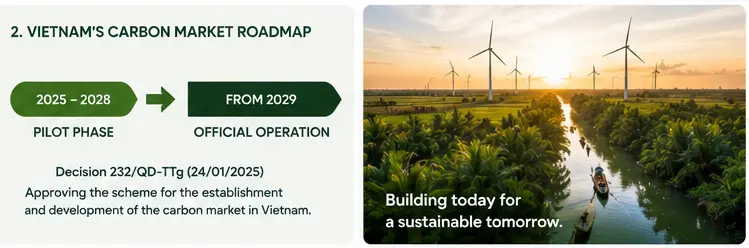
The major shift is that Vietnam is no longer looking only at individual carbon projects. The country is now building a domestic carbon market.
On January 24, 2025, the Prime Minister issued Decision No. 232/QD-TTg, approving the scheme for establishing and developing Vietnam's carbon market.
The roadmap includes:
2025–2028
Pilot phase
Từ 2029
Toward official operation of the domestic carbon market
For businesses and investors, the direction is significant:
The market infrastructure is being built while demand for credible carbon projects is emergin
3. WHY DOES VIETNAM HAVE STRONG POTENTIAL?
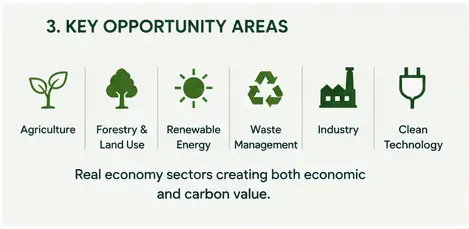
Vietnam has an advantage that not every market has:
A large real economy with many activities capable of creating carbon value.
Potential opportunities exist across:
🌱 Agriculture
🌳 Forestry & Land Use
☀️ Renewable Energy
♻️ Waste Management
🏭 Industry
🔋 Clean Technology
🚚 Logistics & Infrastructure
🏙️ Urban Development
These are not purely environmental activities. They are already part of Vietnam's real economy.
Carbon can create an additional layer of economic value on top of these activities.
4. FORESTRY IS A CLEAR EXAMPLE.
Vietnam has already demonstrated that forests can be connected to carbon finance at meaningful scale.
The FCPF program covered approximately 3.1 million hectares within a total program area of 5.1 million hectares of forests.
The US$51.5 million payment was not simply a payment for planting trees.
It was based on verified emissions-reduction results.
This illustrates a fundamental principle:
Natural resources create carbon value only when their emissions-reduction results can be measured, verified and recognized under an applicable market or mechanism.
5. BUT VIETNAM IS STILL AT AN EARLY STAGE.
This is where investors need to be particularly clear.
Vietnam does not yet have a fully mature carbon market comparable to markets that have operated for many years.
The system is still developing:
Build → Pilot → Refine → Connect
Rules covering emissions allowances, carbon credits, trading and international transfers are also continuing to evolve.
In particular, Decree No. 112/2026/ND-CP, issued on April 1, 2026 and effective from May 19, 2026, provides regulations concerning the international exchange of greenhouse-gas mitigation outcomes and carbon credits.
This represents another step toward creating a legal framework for connecting Vietnam's carbon value with international markets.
6. WHERE ARE THE INVESTMENT OPPORTUNITIES?
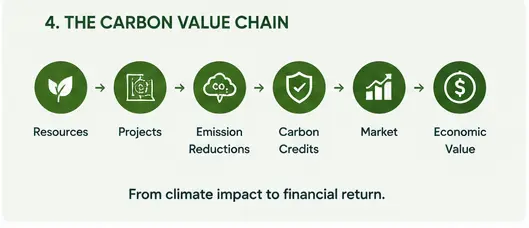
Vietnam's emerging carbon market can be viewed through a simple chain:
NATURAL RESOURCES → PROJECTS → EMISSIONS REDUCTIONS → CARBON CREDITS → MARKET → ECONOMIC VALUE
Vietnam already has substantial resources and real economic activity.
What many projects still need is:
It's:
Capital + Technology + Project Development + Data + Standards + Market Access
This is where investors and project developers can participate.
7. THE OPPORTUNITY IS NOT ONLY IN BUYING CARBON CREDITS
This is an important distinction.
When people hear “carbon market,” they often think:
“Buy credits and sell them later.”
But in an emerging market such as Vietnam, opportunities can appear much earlier in the value chain.
Sample:
🌱 Project Development
Identify and develop projects with genuine emissions-reduction potential.
Project Finance
Provide capital to projects capable of generating both economic returns and carbon value.
💻 Technology
Introduce technologies that improve emissions reduction, measurement and project data.
Carbon Development
Convert verified emissions-reduction outcomes into carbon credits under the applicable standards and mechanisms.
Market Access
Connect credible carbon assets with domestic and international buyers.
The greater value may not be in the final transaction. It may be in building the carbon asset from the beginning.
8. WHERE DOES VIETNAM STAND TODAY?
If we had to describe Vietnam in one phrase:
VIETNAM IS AN EARLY-STAGE CARBON MARKET.
It is no longer:
❌ Only research
But it is not yet:
❌A mature market
Instead, it is moving through:
POLICY → PILOT → PROJECTS → MARKET
This stage can create opportunities for early participants.
But it also requires greater discipline and due diligence.
Not every project described as a “carbon project” will necessarily create a valuable market asset.
9. WHAT SHOULD INVESTORS ASK?
Instead of asking only:
“How much is one carbon credit worth?”
Investors should start with better questions:
Is the project real?
Where does the emissions reduction come from?
Can the results be measured?
Can they be independently verified?
Which mechanism or standard applies?
Is there a real buyer?
What is the cost of generating one credit?
Can the project remain economically viable if carbon revenue is lower than expected?
These questions help distinguish between:
“A carbon story”
and
“A carbon asset capable of creating value.”
10. VIETNAM'S OPPORTUNITY IS BIGGER THAN CARBON
Carbon can become a new layer of value built on Vietnam's real economy.
An agricultural project can create:
Agricultural value + Carbon value
A renewable-energy project can create:
Energy value + Carbon value
A waste-management project can create:
Waste-management revenue + Carbon value
A forest-protection project can create:
Ecological value + Carbon value + Community benefits
This is why carbon is increasingly viewed as more than an environmental issue.
It is becoming a story about capital, assets, technology and project development.

METAHOME VIEW
Vietnam is entering an important transition:
Resources → Projects → Emissions Reductions → Carbon Credits → Markets → Economic Value
The market is still young.
Regulations are still evolving.
Trading mechanisms are still being developed.
But this is precisely why high-quality projects and long-term investors can find meaningful opportunities.
The opportunity may not simply be: finding a carbon credit to buy.
It may be:
Finding the right resource.
Developing the right project.
Bringing the right technology and capital into that project.
Creating measurable emissions-reduction results.
Connecting those results with the right market.
This is how MetaHome views Vietnam's carbon market:
**Not simply as a carbon-credit market.
But as a new project-development market.**
METAHOME INSIGHT
Understand the market. Identify the opportunity. Connect the resources.
This article provides a high-level perspective on Vietnam's emerging carbon market for investors and businesses. Regulations, market mechanisms and applicable requirements may continue to evolve under Vietnamese law.