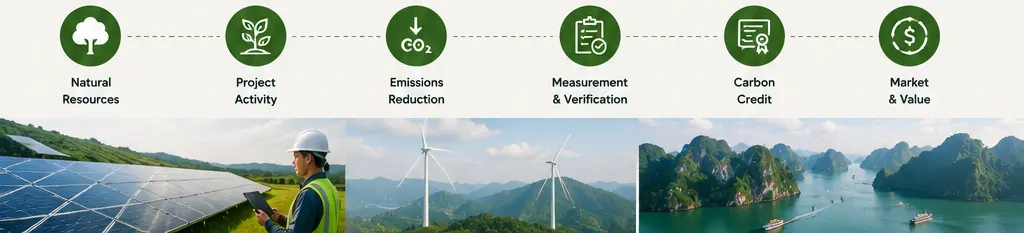
From a real-world project to a marketable carbon asset
When people talk about carbon credits, it is easy to think:
Reduce one ton of CO₂ = create one carbon credit.
In principle, one carbon credit generally represents one metric ton of CO₂ equivalent (tCO₂e) reduced or removed from the atmosphere.
But in practice, turning an emissions reduction into a recognized and marketable carbon credit requires a defined process.
For investors, the process can be understood in six simple steps.
Carbon credits are not created from a “green” idea. They are generated by a real-world project with measurable results that are verified under an appropriate mechanism.
THE 6 STEPS BEHIND A CARBON CREDIT
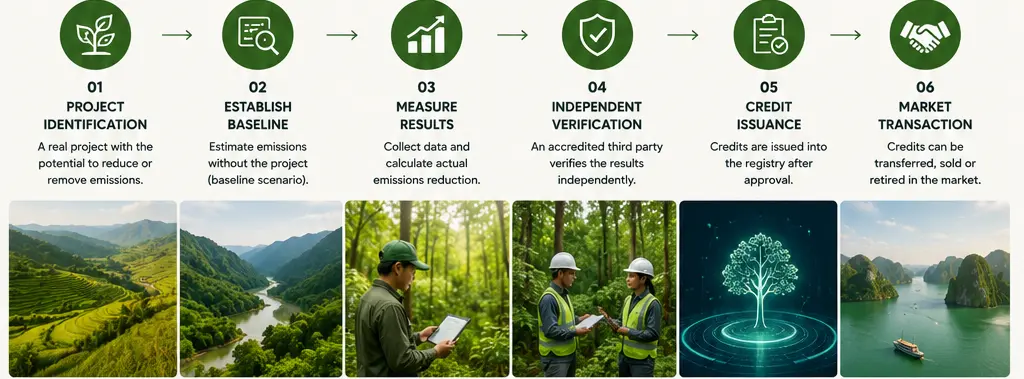
01 — IDENTIFY & DESIGN THE PROJECT
Every carbon credit starts with a real-world activity capable of reducing or removing greenhouse gas emissions.
Potential areas include:
🌱 Agriculture
🌳 Forestry & Land Use
☀️ Energy
♻️ Waste Management
🏭 Industry
🔋 Clean technology
This is where the underlying carbon value begins.
However, a “green” project does not automatically generate carbon credits.
The project needs to clearly establish:
- What activity creates the emissions reduction;
- How the result can be measured;
- Which methodology is appropriate;
- Whether the project meets the relevant requirements.
A good project is the starting point — but it is not yet a carbon credit.

02 — ESTABLISH THE BASELINE
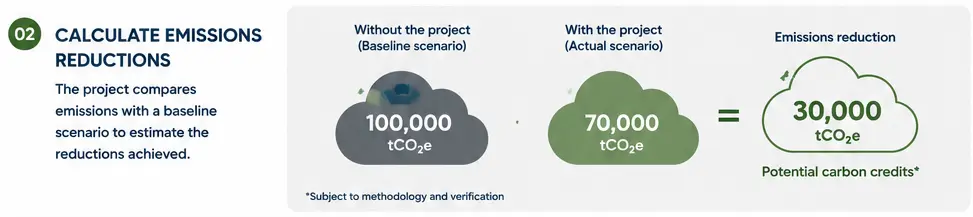
A critical question must be answered: What would happen if the project did not exist? This is the basic idea behind a baseline scenario.
For example:
If a farm continues using its existing practices, it may generate approximately 100,000 tCO₂e of emissions.
After implementing a new approach, emissions may fall to 70,000 tCO₂e..
Conceptually, the 30,000 tCO₂e difference provides the basis for assessing the project's emissions reduction.
But:
100,000 − 70,000 does not automatically create 30,000 carbon credits.
The actual emissions reduction must be determined according to the methodology applicable to the project, together with the relevant requirements for calculation, data and verification.
This is one of the most important points when evaluating a carbon project.
03 — MEASURE THE RESULTS
Once the project is implemented, data is needed to demonstrate what the project has actually achieved.
The process can be viewed simply as:
Real-world activity → Data collection → Calculation → Emissions reduction result
The data may relate to the project's scale, production, energy consumption, waste volumes, forest area, agricultural practices or other indicators relevant to the project.
The fundamental question is:
How much CO₂e has the project actually reduced or removed?
For investors, this is critical.
Without reliable data, it is difficult to demonstrate the value of a carbon asset.

04 — INDEPENDENT VALIDATION & VERIFICATION
This step helps distinguish between a claim of emissions reduction and a result that can be recognized.
The project's results need to be assessed, checked and verified according to the applicable standard or mechanism.
The process generally examines questions such as:
- Was the project actually implemented?
- Is the underlying data reliable?
- Was the appropriate methodology correctly applied?
- Can the reported emissions reduction be demonstrated?
Simply put:
The project produces the result → an independent party checks it → the result is verified.
The quality of this process is an important part of establishing carbon credit credibility..

05 — ISSUE THE CARBON CREDITS
Once the emissions-reduction results meet the requirements of the applicable standard or mechanism and have been verified, eligible carbon credits can be issued and recorded in the relevant registry.
This is the transition from:
“The project has created an environmental outcome”
to:
“That outcome has been recognized as carbon credits.”
For example, if a verified result corresponds to 30,000 tCO₂e, and the applicable mechanism defines one credit as representing one metric ton of CO₂e reduced or removed, the project may have a basis for issuing approximately 30,000 credits.
However: The final number must be based on the verified result and the applicable issuance rules — not simply the project's initial estimate.

06 — BRING THE CREDITS TO MARKET
This is where environmental value connects with economic value.
Once issued, carbon credits may be transferred, traded or used, depending on the type of credit, applicable standard and market rules.
In that case, an emissions reduction project can create not only environmental impact but also a new source of economic value.
The process can be viewed simply:
Project → Emissions Reduction → Carbon Credit → Market → Economic Value
This is where investors begin to ask the more important questions:

Who will buy the credits?
Which markets have demand?
How strong is the credit quality?
What is the market value?
What does it cost to develop the project?
Can the project generate sustainable cash flow?
FROM A GREEN PROJECT TO AN INVESTMENT OPPORTUNITY
The entire process can be summarized as:
01 — PROJECT: A real-world activity capable of reducing or removing emissions.
↓
02 — BASELINE: Establishing what would happen without the project.
↓
03 — MEASUREMENT: Collecting data and determining the emissions reduction.
↓
04 — VERIFICATION: Independent assessment under the applicable mechanism or standard.
↓
05 — ISSUANCE: Eligible results are recorded as carbon credits.
↓
06 — MARKET: Credits can be transferred, traded or used according to applicable rules.
WHAT SHOULD INVESTORS LOOK AT?
The key question is not simply:
“How many carbon credits can this project generate?”
The more important question is:
“Will those credits actually have value in the market?”
A large project is not automatically a good investment opportunity.
Investors should consider the entire value chain:
Emissions-reduction potential + Measurability + Data quality + Verification potential + Credit quality + Market demand + Project development cost + Cash-flow potential
This is how carbon should be evaluated from an investment perspective.
CARBON IS MORE THAN AN ENVIRONMENTAL STORY
Behind every carbon credit is a real economic activity:
Agriculture → Carbon value
Forestry → Carbon value
Energy → Carbon value
Waste management → Carbon value
Industry → Carbon value
Clean technology → Carbon value
This creates a new way of looking at investment:
A project can generate value not only through its products or services, but potentially through the carbon value created by its activities.
This is why carbon is increasingly connected with: agriculture • energy • industry • finance • technology • project development
METAHOME | INVESTOR VIEW
For investors, the objective should not be to chase a headline number of carbon credits.
The real value lies in understanding the entire chain behind those credits:
PROJECT → EMISSIONS REDUCTION → VERIFICATION → CARBON CREDIT → MARKET → VALUE
Once this chain is understood, investors can begin asking better questions:
Which projects have real potential?
Which projects can actually generate eligible carbon credits?
Which projects have credible market demand?
Where is the underlying economic value?
This is the starting point for looking at the carbon market not only as an environmental market, but as an emerging investment and project-development opportunity..
METAHOME INSIGHT
Understand the Market. Identify the Opportunity. Connect the Resources.
This article provides a high-level overview of how carbon credits are created. Actual requirements and processes may vary depending on the project type, applicable standard and market mechanism.