
Industry is more than factories.
When people hear the word industry, they often think of factories, industrial parks, production lines, or containers moving through ports.
Those are only the visible parts.
Behind every factory is a much larger system: raw materials, energy, technology, capital, skilled labor, machinery, logistics, suppliers, customers, and markets.
So, industry is not simply about making products.
Industry is a system that turns resources into economic value at scale and on a repeatable basis.
Understanding this system is the starting point for understanding industrial investment.
1. What Is Industry?
At its simplest,
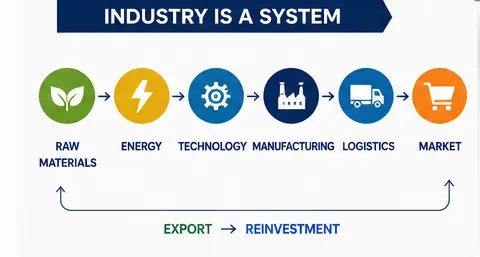
industry is a system of activities that extracts, processes, manufactures, and supplies products or capabilities to the economy, combining resources, capital, technology, energy, and labor.
But
for investors, the more important question is: How does industry create value?
A typical industrial chain can be viewed as:
Raw Materials → Energy → Technology → Manufacturing → Logistics → Market → Export → Reinvestment
Each stage creates value while generating demand for the stages around it.
That is why a factory is only one point within a much larger system.
2. What Does Industry Include?
Industry covers several major areas.
Extractive Industries
Providing raw materials and natural resources.
Manufacturing
Processing materials, components, or inputs into higher-value products.
This is often the area that we associate the most with production activities.
Energy
Providing the power required for factories and the wider economy to operate.
Supporting Industries
Supplying:
- Components;
- Materials;
- Machinery;
- Tooling;
- Equipment ;
- Maintenance;
- Technical services.
High-Tech Industries
Applying advanced technology, automation, data, engineering, and new materials to production.
These areas do not operate independently. Together, they form an industrial ecosystem.
3. The Common Misconception: Industry = Factory
Not quite.
This may be one of the most important misunderstandings.
A factory depends on:
Suppliers → Materials → Power → Water → Machinery → Labor → Logistics → Customers
At the same time, the factory creates demand for many other businesses.
For example, an electronics factory may require hundreds of different inputs and services:
- Components;
- Materials;
- Machinery;
- Equipment ;
- Software ;
- Testing;
- Packaging;
- Logistics;
- Maintenance.
So:
A large factory does not simply produce products. It creates a market around itself.
This is why one major manufacturer can attract an entire network of suppliers and service providers.
4. An Industrial Park Is Not the Same as an Industrial Ecosystem
This distinction matters.
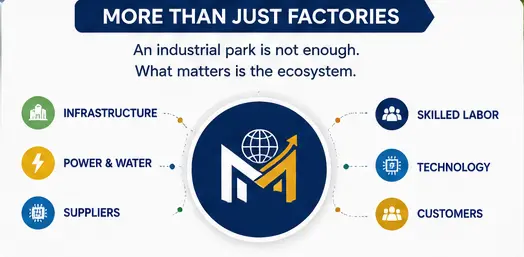
An Industrial Park mainly provides:
Land + Infrastructure
A functioning Industrial Ecosystem requires much more:
Land + Power + Water + Logistics + Suppliers + Labor + Technology + Customers
In other words:
Having industrial land does not automatically create industrial capability.
A location with cheap land but expensive logistics, limited power, or insufficient skilled labor may become more expensive over the long term.
Experienced investors therefore look beyond the price of land.
5. Where Is the Real Value in Industry?
Consider a typical industrial value chain:
Raw Materials → Components → Manufacturing → Assembly → Testing → Packaging → Logistics → Distribution → End Market
But the value chain goes beyond physical production.
It also includes:
- Technology
- Engineering
- IP
- Branding
- Distribution
One important principle is often overlooked:
High revenue does not necessarily mean high value capture.
A manufacturing operation may generate significant revenue while capturing less value than the technology, design, intellectual property, brand, or distribution behind the product.
This is the reason why, when analyzing an industry, professional investors do not just ask:
“How much does this product sell for??”
This leads to a better investment question:
“Who captures the greatest share of value in the chain?”
6. Upstream, Midstream and Downstream
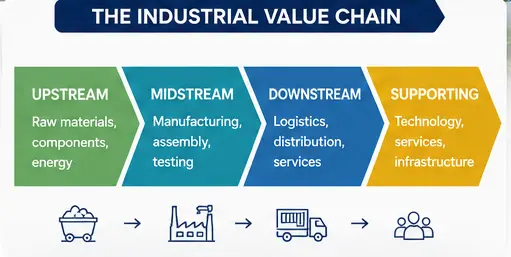
A simple way to understand industrial structure is to divide it into three layers.
Upstream
The inputs:
- Raw materials;
- Components ;
- Energy;
- Materials;
- Core technologies.
Midstream
The production process:
- Processing;
- Manufacturing;
- Assembly;
- Testing;
- Packaging.
Downstream
The route to the market:
- Logistics;
- Distribution;
- Sales;
- Export;
- After-sales services.
Alongside these sits another important layer:
Supporting industries
These businesses may not produce the final product, but they provide capabilities that many manufacturers need.
Examples include:
Automation, industrial software, testing, certification, maintenance, engineering, logistics, waste treatment, and energy efficiency.
7. Why Do Industrial Clusters Matter?
One successful factory can trigger a wider chain:
One Factory → Suppliers → Workers → Logistics → Services → Infrastructure → More Factories
This is the industrial cluster effect.
As businesses become concentrated within the same ecosystem, specialized labor, suppliers, infrastructure, and services can develop around them.
The result is more than a collection of factories.
One factory can be an investment. An industrial cluster can become a market.
8. Is Land + Capital + Factory Enough?
Not quite.
This is one of the most common mistakes in industrial investment.
A project can struggle if it lacks:
- Suitable raw materials ;
- Reliable power ;
- Efficient logistics;
- Skilled labor;
- Environmental compliance ;
- Qualified suppliers, Customers ;
- Customers Export capability ;
- Supply-chain integration .
Therefore, land is only one input.
The real value of an industrial location is its ability to combine all critical inputs into a competitive operating model.
9. How Do Experienced Investors Look at Industry?
A new investor may ask:
“Where is industrial land available?””
An experienced investor is more likely to ask:
“Where can this project build a sustainable competitive advantage within the industrial value chain?”
These are very different questions.
The first looks for an asset.
The second looks for an economic advantage.
That requires examining:
- Market demand ;
- Raw materials;
- Energy;
- Labor;
- Technology;
- Logistics;
- Logistics;
- Regulation;
- Supply chains;
- Customers ;
- Capital .
This is why a strong industrial project should begin with an Investment Thesis and an economic feasibility assessment, not simply with land acquisition.
10. Investment Opportunities Are Not Limited to Factories
This is where the industrial ecosystem becomes particularly interesting.
As manufacturing grows, demand increases not only for finished products, but also for the capabilities supporting production.
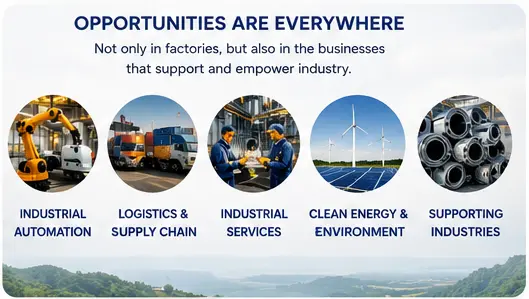
Opportunities can emerge in:
- Industrial Automation
- Industrial Software
- Testing & Certification
- Engineering Services
- Maintenance
- Industrial Logistics
- Cold Chain
- Energy Efficiency
- Waste Treatment
- Industrial Utilities
In other words:
The biggest opportunity is not always inside the biggest factory. Sometimes it is in the capability that hundreds of factories need.
This leads to an important investment principle:
11. Where Does Vietnam Stand?
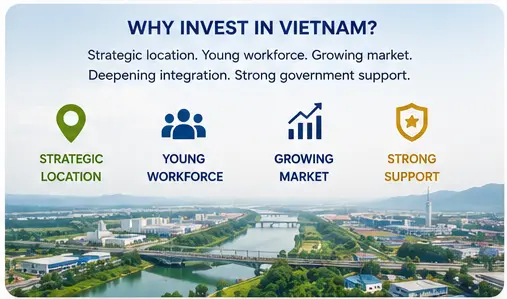
Vietnam has developed a significant manufacturing base and has become increasingly integrated into regional and global supply chains.
But looking only at factory numbers or FDI flows misses a deeper question:
How much value does Vietnam actually capture across the industrial value chain?
A stronger industrial base requires more than production and assembly.
It gradually needs:
Suppliers → Engineering → Technology → R&D → Automation → Industrial Services → Intellectual Property
Therefore, Vietnam's next opportunity may not simply be building more factories.
It may be about building the capabilities that future factories will increasingly depend on.
That is the foundation of a deeper industrial ecosystem.
12. Don't Ask Only: “Which Industry Is Hot?”
For industrial investment, “Which sector is hot?” is rarely enough.
A better framework is to ask five questions:
01. Is there real demand?
Is the market structurally growing, or is this only a short-term trend?
02. Where is the capability gap?
What do existing companies still lack?
03. What are the barriers to entry?
If everyone can enter easily, the competitive advantage may be weak.
04. Where is value captured?
Large revenue does not automatically mean attractive margins.
05. Is the advantage sustainable?
A strong industrial investment should remain competitive beyond a short market cycle.
This is the shift from “finding a hot sector” to finding a strong Investment Case.
13. Myth vs Reality
❌ MYTH
Industry is about factories. .
✅ REALITY
Factories are only one part of an industrial ecosystem.
❌ MYTH
Cheap industrial land creates a competitive advantage.
✅ REALITY
The real question is the total operating cost and the ability to access power, labor, logistics, suppliers, infrastructure, and markets.
❌ MYTH
More FDI automatically means a stronger industrial economy.
✅ REALITY
The deeper question is what technology, suppliers, capabilities, and domestic value FDI creates.
❌ MYTH
The biggest opportunity is always to build a factory
✅ REALITY
Some of the strongest opportunities may exist in the technologies, services, infrastructure, and capabilities that many factories require.
14. Investor Lens
Industry can be simplified into one investment framework:
Industrial Opportunity = Demand + Capability Gap + Infrastructure + Technology + Supply Chain + Capital
The Capability Gap is particularly important.
As industrial activity expands:
More Factories → More Demand → Supplier Gaps → Technology Needs → Infrastructure Needs → New Services → New Investment Opportunities
This is why experienced investors do not look only at what Vietnam already has.
They also ask:
“What will Vietnam need next that it does not yet have enough of?”
That question often reveals the more interesting opportunities.
Conclusion: Understand Industry to See What Comes After the Factory
Industry is not a building.
It is not simply industrial land.
It is not a production line.
And it is not only manufacturing.
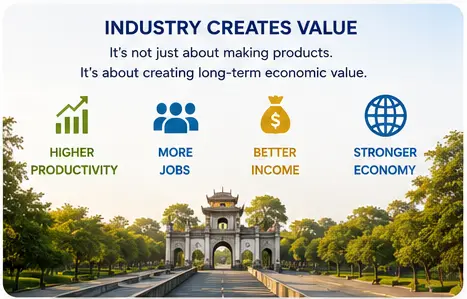
Industry is a system for creating value.
As the system develops, it creates opportunities across:
Raw Materials → Manufacturing → Technology → Suppliers → Logistics → Infrastructure → Services → Markets → Reinvestment
For Vietnam, the next question is not simply:
“How many more factories can we build?”
The more important question is:
“How much more high-value industrial capability can we build?”
And for investors:
The opportunity is not always where the most businesses already exist. Sometimes it is in the gaps created by their growth.
That is where understanding industry becomes more than knowledge. It becomes a way to identify the next business and investment opportunity.