
E-commerce Is Not Just a Website
When people talk about E-commerce, they often think of an online marketplace, an online store, or someone selling products through social media.
That is only the visible part.
At its core, e-commerce is an economic system in which the discovery, presentation, transaction, payment, and distribution of goods or services are supported by digital technology.
Simply put:
E-commerce is not just where buyers and sellers meet. It is the system that enables a transaction to happen, be paid for, fulfilled, delivered, managed, and turned into data.
This is the foundation of this series: rather than starting with a specific platform, we start with the economic structure behind an online transaction.
1. E-commerce, Online Retail and Digital Commerce: Are They the Same?
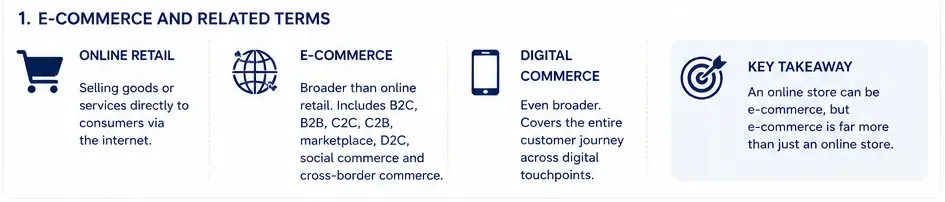
Not exactly.
Online Retail
Selling goods or services directly to consumers through the Internet.
For example, a brand selling products through its own website.
E-commerce
E-commerce is broader than online retail.
It includes:
- B2C — Business to Consumer
- B2B — Business to Business
- C2C — Consumer to Consumer
- C2B — Consumer to Business
- Marketplace
- D2C
- Social Commerce
- Cross-border E-commerce
Digital Commerce
Digital Commerce is broader still
It can cover the entire customer journey: customer reach → interaction → transaction → payment → service → data across multiple digital channels.
Therefore:
An online store can be e-commerce, but e-commerce is far more than an online store.
2. What Really Happens in an E-commerce Transaction?
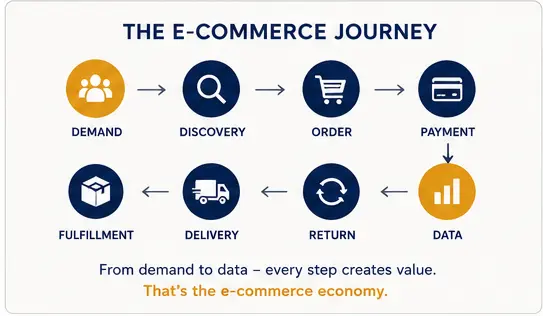
Take something simple: a pair of shoes.
A customer sees the product online.
But before those shoes reach the customer, many layers behind the screen must work together.
Demand
The customer has a need.
↓
Discovery
The customer finds the product.
↓
Order
The customer places an order.
↓
Payment
The transaction is paid for or payment is confirmed..
↓
Fulfillment
The order is processed and prepared.
↓
Delivery
The product is transported to the customer.
↓
Return
If necessary, the product can be returned or exchanged.
↓
Data
Every step generates valuable data.
This is the basic transaction chain that allows us to understand e-commerce as an economic system, rather than simply as an online storefront.
The important point:
A customer may see only a few minutes.
But a business has to operate the entire system behind those minutes.
That is where many business opportunities are created.
3. The 8 Layers of the E-commerce Ecosystem
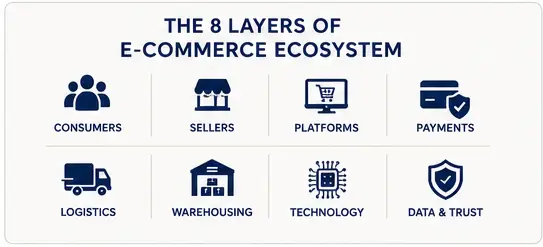
A complete e-commerce market requires at least eight layers:
1. Consumers
They create demand.
2. Sellers
They provide goods and services.
3. Platforms
They connect supply and demand.
4. Payments
They turn transactions into cash flow. .
5. Logistics
They move products from sellers to customers.
6. Warehousing
They store, sort, and process products.a.
7. Technology
It makes the entire system more efficient.
8. Data & Trust
They help the system understand customers and reduce transaction risk.
This distinction matters:
E-commerce is an ecosystem, not an industry made up of only buyers and sellers.
4. Common Misunderstandings
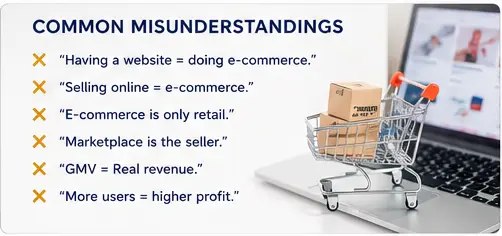
“Having a website means you are doing e-commerce.”
Not necessarily.
A website is only a channel.
Without payment, order processing, logistics, customer service, and data capabilities, a website alone does not create a complete e-commerce system.
“Selling online = e-commerce.”
Not exactly.
Online selling is one activity.
E-commerce is an operating system for business transactions.
“E-commerce is just retail.”
This is one of the biggest misunderstandings.
E-commerce also connects with:
- Logistics
- Warehousing
- Payments
- Technology
- Data
- Advertising
- SaaS
- AI
- Cybersecurity
- B2B
- Cross-border commerce
Therefore, a company does not need to sell directly to consumers to benefit from e-commerce growth. It can provide the infrastructure, technology, services, or systems that make e-commerce possible.
“The marketplace is the seller.”
No.
A marketplace is primarily the layer that connects participants and organizes transactions.
Sellers, brands, logistics providers, payment companies, advertisers, and technology providers each create different parts of the value.
5. A Critical Principle: GMV ≠ Revenue ≠ Profit

This is one of the easiest points for new investors to misunderstand.
GMV — Gross Merchandise Value
The total value of goods transacted through a platform.
Revenue
The income actually recognized by the company.
Profit
What remains after relevant costs are deducted.
Enterprise Value
The value of the entire business in the capital market.
These four numbers are not the same.
A platform can have very large GMV and still have thin margins because it spends heavily on:
- promotions,
- advertising,
- Logistics,
- customer acquisition,
- Technology,
- operations.
Therefore:
Therefore: Do not ask how much a platform sells before asking how much value it actually keeps.
This is a fundamental principle when analyzing an E-commerce business.
6. Why Can a Marketplace Grow So Quickly?
One important concept is the Network Effect.
In simple terms:
More buyers
→ more sellers want to join
→ more products become available
→ customers have more choices
→ more buyers join.
This creates a growth loop.
But Network Effect does not mean:
“More users automatically mean more profit.”
These are two different questions.
A platform must turn transaction scale into healthy economics.
That is the real challenge.
7. Where Is the Real Value Created?
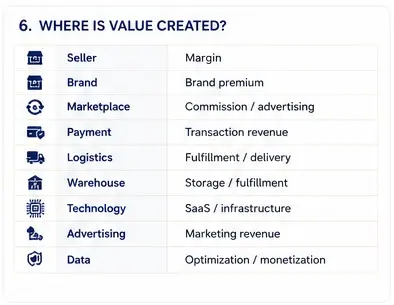
This is perhaps the most important question.
If e-commerce only means putting buyers and sellers on the Internet, competition can quickly reduce the value of that position.
But when we look at the full ecosystem, we see different sources of value:
Seller → Margin
Brand → Brand Premium
Marketplace → Commission / Advertising
Payment → Transaction Revenue
Logistics → Fulfillment / Delivery
Warehouse → Storage / Fulfillment
Technology → SaaS / Infrastructure
Data → Optimization
This leads to an important insight:
The biggest business opportunity is not necessarily where the most orders happen.
It may be in the infrastructure behind those orders.
8. Where Is Vietnam Today?
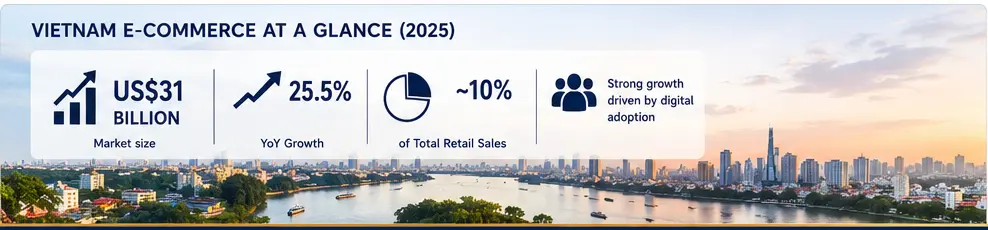
Vietnam already has an e-commerce market large enough to be considered a significant economic sector.
According to the Ministry of Industry and Trade, Vietnam's e-commerce market reached approximately US$31 billion in 2025, growing 25.5% and accounting for around 10% of total retail sales of goods and services.
The number matters. But investors should not stop at market size.
The more important question is:
How much demand does that US$31 billion create for the services and infrastructure behind it?
As transaction volumes increase, demand also grows for:
- Warehousing,
- Fulfillment,
- Logistics,
- Payments
- Technology,
- Data,
- AI,
- Cybersecurity,
- Cross-border E-commerce.
This is how we move from market size to investment opportunity.
9. What Does E-commerce Need to Grow?
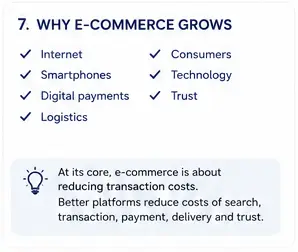
An e-commerce market cannot develop through Internet access alone.
Several conditions need to come together:
Internet
- Smartphone
- Smartphones Consumers
- Digital Payments
- Logistics
- Technology
- Trust
If one of these links is weak, transaction costs increase.
At its core, e-commerce is therefore also a Transaction Cost problem.
A well-designed system reduces:
- search costs,
- transaction costs,
- payment costs,
- distribution costs,
- trust-building costs.
That is why technology can create significant economic value even when the technology company does not directly sell the final product.
10. The Regulatory Framework: Vietnam Enters a New Phase
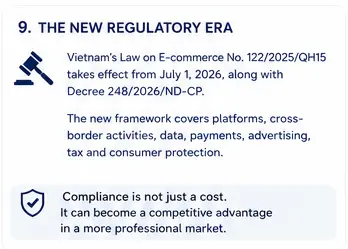
From July 1, 2026, Vietnam officially applies the Law on E-commerce No. 122/2025/QH15. The law provides a dedicated legal framework for e-commerce, covering areas including e-commerce platforms, activities involving foreign elements, e-commerce support services, and the use of technology in management.
On the same date, Decree No. 248/2026/ND-CP,
which provides detailed provisions under the Law, also took effect.
This matters because e-commerce is no longer simply about:
seller + buyer
It increasingly involves:
platforms + data + payments + advertising + taxation + consumer protection + responsibilities of digital participants.
An important perspective:
Regulation is not only a compliance cost. In a maturing market, compliance can become a competitive advantage.
As market standards rise, businesses with stronger operations, technology, data capabilities, and compliance systems can build a level of trust that smaller players may find difficult to replicate.
11. Where Are the Business Opportunities?
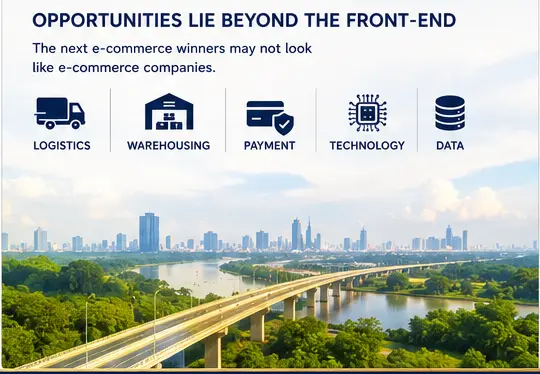
If we only look at:
“Opening an online store.”
we are looking at the most visible layer of the market.
An investor should ask a different question:
Where is market demand growing faster than the capacity to serve it?
Potential opportunities include:
- Fulfillment
- Smart Warehousing
- Logistics Technology
- Digital Payment
- AI Commerce
- E-commerce SaaS
- Cross-border E-commerce
- B2B Digital Commerce
- Data
- Cybersecurity
This represents a shift from “selling online” to “building the infrastructure for the online economy.” As the front-end becomes more competitive and crowded, value can increasingly move toward the infrastructure layers behind it.
12. How Do Experienced Investors Look at E-commerce?
They do not ask only:
“How large is the market?”
They also ask:
1. Demand
Where does real demand come from?
2. Unit Economics
How much value does each transaction create?
3. Infrastructure
What infrastructure is the market missing?
4. Data
Who owns and uses the data?
5. Regulation
How is the rulebook changing?
6. Competition
How sustainable is the competitive advantage?
7. Capital
Capital How much capital is required to scale?
8. Scalability
Can the business grow without costs increasing at the same rate?
This is the shift from: “finding a growing industry” to: “finding the position within that industry where value can be created.”

CONCLUSION: E-COMMERCE IS NOT JUST “SHOPPING ONLINE”
E-commerce is a digital economic system.
It connects:
Demand
→ Sellers
→ Platforms
→ Payments
→ Warehousing
→ Logistics
→ Customers
→ Data
As the market grows, value does not necessarily remain where consumers can see it.
The opportunity may lie in the very systems that make an online transaction possible.
That is why a logistics company, a fulfillment center, a payment platform, an AI company, a SaaS provider, or a data infrastructure business can all be part of the E-commerce economy, even if they never sell a product directly to consumers.
So the right question is not:
“Will Vietnam's e-commerce market continue to grow?”
The more important question is:
“As e-commerce continues to grow, which layer of the value chain will benefit the most?”
That is the question we will explore in the next article:
References
- Vietnam Ministry of Industry and Trade — Vietnam e-commerce market data.
- Government Portal — Legal Documents — Law on E-commerce No. 122/2025/QH15, issue 10/12/2025, effectiveness 01/07/2026.
- Vietnam Ministry of Industry and Trade — e-commerce regulatory implementation Decree No. 248/2026/ND-CP from 01/07/2026.