
From traditional schools to an ecosystem for human capital and economic opportunity
When people talk about education in Vietnam, they often think of schools, teachers, and students.
From an economic and investment perspective, however, that is only the most visible part.
Education is increasingly becoming a broader ecosystem that develops human capital, skills, and capabilities for the economy. This is the starting point of MetaHome’s Education & Training in Vietnam series.
1. What does education really mean?
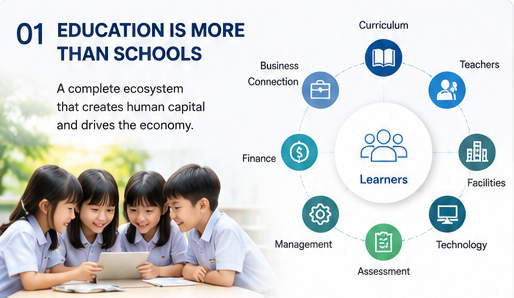
An education system is more than a classroom.
It includes:
Learners → curriculum → teachers → infrastructure → technology → assessment → management → businesses → employment.
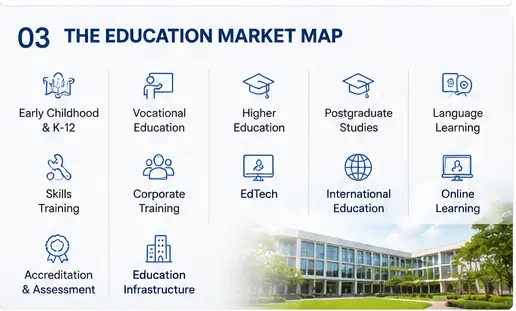
That is why the education market is much broader than building and operating schools.
It also includes:
- Early childhood and K-12 education
- Higher education
- Vocational education
- Language and skills training
- Corporate training
- International education
- EdTech
- Online learning
- Assessment and accreditation
- Education infrastructure
2. What do newcomers often get wrong?
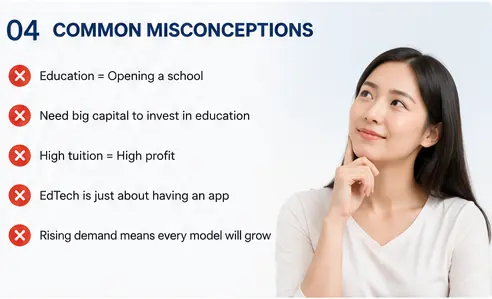
Misconception 1: Education means opening a school
Not necessarily.
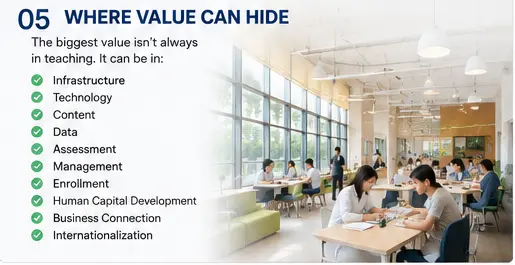
Opportunities can also exist in technology, content, infrastructure, data, assessment, management, student recruitment, and workforce training.
Misconception 2: Education always requires very large capital
Not every model has the same capital requirements.
A training center, an EdTech platform, and a university have very different capital structures and operating models.
Misconception 3: Higher tuition means higher profit
Not necessarily.
Investors need to look at teacher costs, utilization, student retention, capital expenditure, and payback period at the same time.
Misconception 4: EdTech is simply about building a good app
A strong education technology product still needs quality content, users, a viable revenue model, and the ability to retain learners.
Misconception 5: Growing education demand means every segment will grow
This is one of the most important misconceptions.
Rising demand does not mean every education segment offers the same opportunity.
The stronger opportunities often appear where there is a gap between demand and supply.
3. An important perspective: Value is not only created by teachers
An experienced investor does not ask only:
“How many students are there?”
The better question is:
“What problem is the education system solving, and where is value being created?”
Value can come from:
Infrastructure + Technology + Content + Data + Management + Assessment + Business Connections + Internationalization.
This represents an important shift: from seeing education simply as teaching to understanding it as a broader economic ecosystem.
4. Why is education becoming more closely connected to the economy?
A changing economy requires new capabilities.
Businesses need engineers.
Factories need skilled technicians.
Technology companies need digital talent.
Emerging industries need skills that traditional education may not yet provide at sufficient scale.
This creates a simple chain:
Investment → Business → Jobs → Skills Demand → Training → Productivity
As Vietnam develops its FDI base, industrial economy, digital economy, AI, semiconductor sector, and green transition, the demand for high-quality talent is also changing.
5. Vietnam is moving from “learning for a degree” toward “learning for capability”
This is an important shift.
In a rapidly changing economy, learning does not necessarily end when a person graduates.
Workers need to continuously update their skills. Businesses need to retrain their people. Technology continues to create new requirements.
As a result, Learning Demand can extend throughout a person’s working life.
This makes areas such as:
- Vocational training
- Corporate Training
- AI Training
- Semiconductor Training
- Engineering
- Logistics
- Energy
- Healthcare
increasingly relevant from a Human Capital perspective.
6. Where are the opportunities?
This is the key question for investors.
Do not look only for markets with high demand.
Look for:
Demand–Supply Gaps
In simple terms:
What does the economy need that the education market is not yet supplying at sufficient scale or quality?
These gaps can emerge in schools, vocational education, corporate training, EdTech, international education, or education infrastructure.
And that is where a social need can become a long-term business opportunity.
7. Where is Vietnam’s education sector heading?

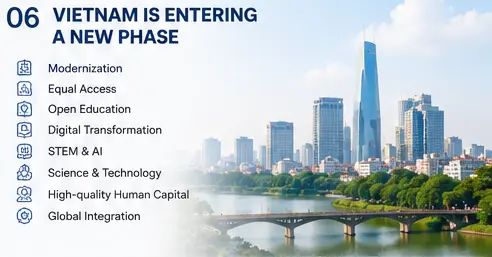
Vietnam’s development direction toward 2030, with a vision to 2045, places increasing emphasis on:
Digital transformation → STEM → AI → science and technology → high-quality talent → international integration.
This points to a larger question for the future:
“How many more schools are there?”
But also is:
“What capabilities does Vietnam need to build for the next economy?”
8. The investment perspective

Therefore, the right question is not simply:
“Should we invest in education in Vietnam?”
The better question is:
“Where in the education ecosystem is the largest gap emerging?”
It could be a school.
But it could also be a technical training center, an EdTech platform, an AI training program, international education, education services, or infrastructure supporting education.
The opportunity is not only in teaching.
The opportunity is in building the capabilities behind Vietnam’s future economy.
MetaHome Insight
Education is no longer only about classrooms.
It is about building the human capital behind Vietnam’s next economic cycle.
MetaHome looks at education not simply as a social sector, but as part of Vietnam’s long-term human capital infrastructure and investment opportunity