
From Sunlight and Wind to Cash Flow
Investment Thesis
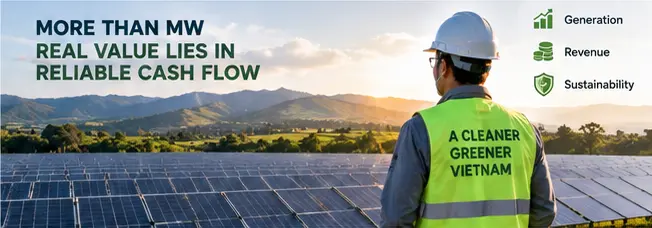
The value of a renewable energy project does not lie in the number of MW installed, but in its ability to turn natural resources into electricity that can be transmitted, sold, collected for, and generate sufficiently reliable cash flow to support financing.
This is the first thing to understand before looking at any solar, wind or energy storage project.
The outline of the MetaHome series also identifies that this article has a clear mission: to help readers break free from the mindset of only looking at MW capacity and understand the chain from generation to consumption.
1. The Real Issue Is Not Simply Generating Electricity
A solar power project may have excellent solar irradiation.
A wind power project may have highly attractive wind speeds.
But electricity generated does not automatically become revenue.
Between natural resources and cash flow lies a long chain:
Natural Resources → Power Generation → Power Conversion → Grid Connection → Transmission → Dispatch → Customer → Payment
If any critical link is weak, the project's economic value can change significantly.
That is why professional investors do not simply ask:
“How many MW does the project have?”
They ask:
“How much electricity can actually be generated, how much can be delivered to the grid, who will buy it, under what conditions, and how reliable is the resulting cash flow?”
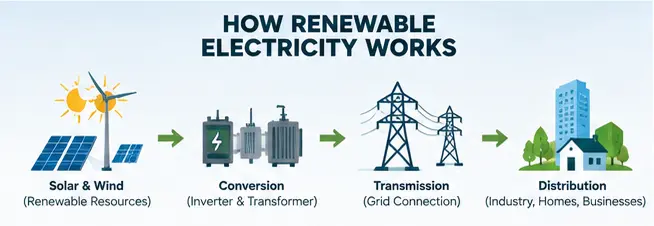
2. How Does a Renewable Power System Actually Work?
In principle, the system is relatively simple.
Solar
Power Sunlight is converted into direct current by photovoltaic panels. An inverter converts that electricity into alternating current suitable for the power system. The electricity then passes through transformers, substations and the grid connection point before entering the grid.
Wind
Power Wind turns turbine blades. Mechanical energy is converted into electricity, which is then collected through the internal electrical system, transformer substation and grid connection line.
But the key issue for investors is not the physics.
It is:
To what extent can the electricity be accepted by the power system and commercialized?
That is the line between a technical asset and an investable asset.
3. What Newcomers Often Get Wrong: 100 MW Does Not Mean 100 MW of Continuous Power
This is a very common misconception.
MW measures power capacity.
MWh measures the amount of electricity generated or consumed over a period of time.
A 100 MW power plant does not mean it generates 100 MW continuously, 24 hours a day.
Solar power does not generate electricity at night.
Wind conditions change.
Equipment requires maintenance.
The grid may have limits on how much electricity it can accept.
Therefore, two projects with the same 100 MW capacity can generate completely different levels of electricity and cash flow.
Experienced investors also look at three additional factors:
- Capacity factor: how much the plant actually produces compared with its theoretical maximum.
- Equipment availability: whether the system is operating when the resource is available.
- Electricity delivered for settlement: the portion of electricity ultimately generating revenue.
This is a critical point:
Installed capacity is a technical measure of scale. Electricity actually sold is the foundation of cash flow.
4. What Really Determines the Value of a Project?
Five factors matter more than simply looking at capacity.
1. Resource Quality
Solar irradiation, wind conditions or water availability determine how much electricity can potentially be generated.
But strong natural resources are only the first condition.
2. Grid Connection and Transmission Capacity
If a plant can generate electricity but the grid cannot fully receive it, strong natural resources will not create equivalent value.
3. Power Sales Mechanism
The project must clearly answer:
- Who buys the electricity?
- How is the price determined?
- How long is the contract?
- How are payments made?
- Who bears the risk when generation is constrained?
4. Cost of Capital
Renewable energy is a capital-intensive industry.
A relatively small change in interest rates, debt ratio or construction period can have a significant impact on equity returns.
5. Execution Capability
Land, permits, contractors, equipment, grid connection, construction schedule and operations all directly affect whether the project can generate cash flow as planned.
In short:
A good project is a combination of resources, infrastructure, commercial contracts, capital and execution capability.
5. Where Is Vietnam in This Equation?
What matters about Vietnam is not simply the need to develop more power generation.
More importantly, the power system will need to expand rapidly while becoming more flexible at the same time.
The revised Power Development Plan VIII, approved under Decision No. 768/QD-TTg, targets total installed system capacity of approximately 183,291–236,363 MW by 2030.
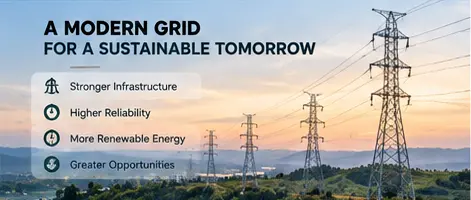
The plan also identifies significant development requirements for transmission grids and energy storage systems.
Fact
Vietnam is planning power generation + transmission + energy storage at the same time.
Interpretation
This indicates that the challenge is shifting from “building more power plants” to “building a system capable of absorbing and managing additional electricity”.
Investment Implication
As a result, value may increasingly shift toward less visible parts of the system:
power grids, substations, energy storage, control systems, forecasting, energy management and system services.
This is also consistent with MetaHome's strategic perspective: Vietnam needs not only additional power generation, but also transmission, storage, smart grids and long-term capital.

6. Why Is Energy Storage Becoming Important?
Renewable electricity has one defining characteristic:
The time electricity is generated does not always match the time when the system needs it most.
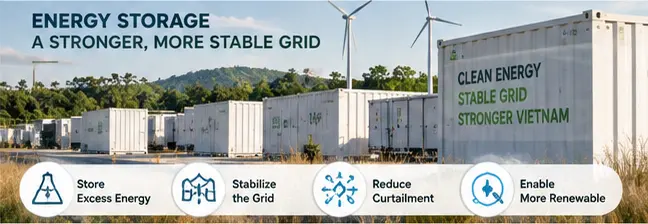
This is where battery energy storage systems — BESS — begin to create value.
BESS can help:
- store electricity when supply is abundant;
- discharge electricity when demand is higher;
- support system balancing;
- respond rapidly to frequency fluctuations;
- reduce some of the pressure created by variable generation.
By the end of 2025, the Ministry of Industry and Trade had issued a methodology for developing price frameworks and determining power generation service prices for certain battery energy storage systems connected to the national power system, indicating that BESS is gradually moving from a technical concept toward a more clearly defined commercial component.
But the important point is:
Installing batteries does not automatically create a good business model.
Investors must clearly identify how the storage system generates revenue or reduces costs.
7. What Is Changing in the Market Framework?
Renewable energy investment cannot be evaluated from a technical perspective alone. Regulation is part of project value. Vietnam's Electricity Law 2024, which took effect on February 1, 2025, introduced a specific legal framework for renewable energy, new energy, self-generation and self-consumption, as well as provisions covering investment, the electricity market and power purchase agreements.
Another notable development is the mechanism for direct power trading between renewable energy generators and large electricity customers.
This does not mean every project will suddenly become easier to develop.
But it changes an important question:
Previously, investors mainly asked:
“Who will buy electricity from the project?”
Now, under certain suitable models, the question can expand to:
“Can a more direct commercial relationship be established with large electricity customers?”
This is a development worth watching for manufacturers, industrial parks, data centers and businesses with significant demand for clean electricity.
8. Investment Perspective: Where Is the Money Actually?
This is the most important section.
The most visible opportunity is:
Building a solar or wind power plant.
But that is not necessarily the most attractive part of the value chain.
Value may lie in four other layers.
Power generation assets: suitable for infrastructure investors with the ability to manage projects, capital and long-term contracts.
Infrastructure: transmission, substations, storage and other components that allow the system to absorb additional electricity.
Technology: power forecasting, control systems, operational optimization, energy management and load management.
Services: operations, maintenance, electricity cost optimization, industrial energy management and support for large electricity customers.
Where is the Moat — the hard-to-replicate advantage?
In this industry, competitive advantage does not necessarily come from proprietary technology.
It may come from:
- access to high-quality sites;
- grid connection capability;
- relationships with electricity buyers;
- sufficiently mature project pipelines;
- ability to raise capital;
- reliable supply chains;
- execution teams;
- a portfolio of multiple projects rather than a single project.
The opportunity is not necessarily in creating another MW of electricity. It may lie in making that MW more reliable, easier to sell and easier to finance.
9. Vietnam's Opportunity Map
| Opportunity | Why it matters now? | Who can participate? | Key requirement | Main risk |
| Solar and Wind Power | Continued demand for new power capacity | Developers, infrastructure funds, strategic investors | Planning, land, grid connection, off-take | Delays, grid constraints, contracts |
| BESS | Rising share of variable generation | Infrastructure investors, battery companies, technology firms | Clear revenue model | Cost, lifespan, market mechanism |
| Grid Connection Infrastructure | Power generation is developing rapidly in many areas | Contractors, equipment providers, infrastructure developers | Coordinated planning | Long investment cycle |
| Power for Industrial Customers | Large businesses increasingly value clean and reliable power | Generators, industrial parks, large customers | Appropriate contract structure | Price, generation, regulation |
| Energy Management Technology | The power system is becoming more complex | Technology and automation companies | Practical integration capability | Technology not aligned with actual demand |

10. What Do Experienced Players Actually Watch?
New investors look at MW.
Experienced investors look at other things.
1. Actual Generation
Not nominal capacity, but the amount of electricity that can actually be generated and sold.
2. Grid Absorption Capability
Where is the grid connection point? Does the grid have sufficient capacity? When will the relevant infrastructure be completed?
3. Off-take Quality
Who buys the electricity? How strong is their ability to pay? How are risks allocated under the contract?
4. Financing Capability
A project can show attractive returns on a spreadsheet and still not be bankable — meaning it is not yet strong enough in structure and risk profile for banks or institutional investors to finance.
5. Execution Capability
Can the project secure land, permits, engineering, procurement, construction and operations within the required schedule?
These are the factors that determine whether a technical opportunity can become an investable asset.

If You Remember Only Three Things
First: MW is not cash flow. Actual electricity generation and electricity sold determine the economics of the project.
Second: renewable electricity does not exist in isolation. Its value depends on the grid, energy storage, customers and the ability to operate the wider system.
Third: the most attractive part of the next investment cycle may not be limited to power generation assets, but to the infrastructure and technology that make electricity more flexible, commercially viable and financeable
Vietnam is entering a period in which the scale of the power system needs to expand rapidly; at the same time, the revised Power Development Plan VIII continues to be reviewed in 2026 to respond to new development requirements.
Therefore, the investor's question is no longer simply:
“Should I invest in solar or wind power?”
It is:
“Across the entire journey from energy source to cash flow, which link is currently underserved — and who can create value at that point?