
A company buys an ERP system.
A bank allows customers to open an account on their phones.
A hospital moves medical records from paper to an electronic system.
A factory uses sensors to monitor its production line in real time.
A government agency provides public services online.
A company uses AI to support its customer service employees.
All of these involve digital technology. But does that mean all of them are already “digital transformation”?
Not necessarily.
This is the first point that needs to be clarified.
Digital transformation does not begin with the question of what technology a company should buy. It begins with a more fundamental question: how does a business, organization, or economy currently create value and operate — and how can it do better through data and technology?
That is also the foundation of this series: digital transformation is not treated simply as a technology topic, but as a process that changes how data, people, technology, infrastructure, organizations, and business models work together to create value.
1. First, What Does “Digital Transformation” Really Mean?
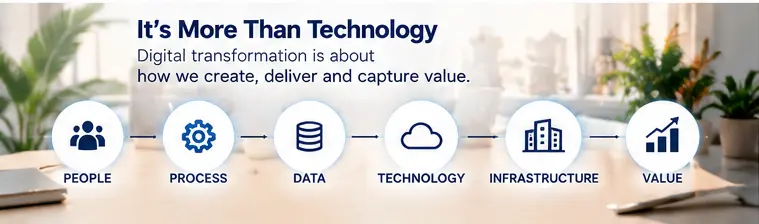
Put simply:
Digital transformation is the process of using data and digital technologies to significantly change how an organization operates, makes decisions, delivers products or services, and creates value.
The OECD distinguishes three related concepts:
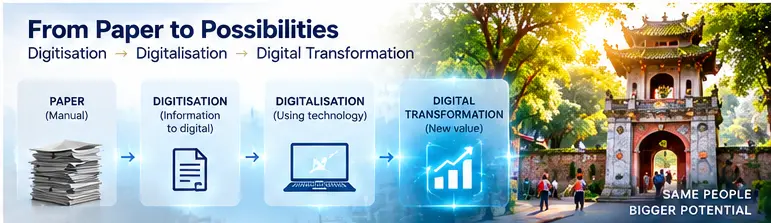
- Digitisation: converting data or information from an analogue form into a machine-readable format.
- Digitalisation: using digital technologies, data, and the connections between them to change or create new activities.
- Digital transformation: the broader changes that digitalisation creates across the economy and society.
Put more simply:
Digitisation turns information into data.
Digitalisation changes how work is done through digital technology.
Digital transformation changes how an organization creates value.
These three concepts are closely related, but they are not the same thing.
2. Digitisation, Computerisation and Digital Transformation: What Is the Difference?
This is one of the areas newcomers most often misunderstand.
Level 1 — Digitisation
A company used to store contracts on paper.
Now it scans them into PDFs and stores them on a computer.
That is digitisation of information.
The information has moved from a physical format into digital form.
But the underlying process may remain exactly the same.
Level 2 — Computerisation / Technology Adoption
A company begins using:
- ERP;
- CRM;
- accounting software;
- human resource management software;
- cloud;
- production management systems.
Work becomes faster and more systematic.
But if each system operates independently, data is not connected, and decision-making does not change significantly, the organization may still not have achieved genuine digital transformation.
Level 3 — Digital Transformation
The company begins redesigning the way it operates around:
Data → Technology → Process → People → Decision → Value
For example:
Instead of simply storing customer data in a CRM, the company connects sales, marketing, customer service, and customer behavior data.
The data is analyzed.
The system identifies trends.
Employees receive the right information at the right time.
The company changes how it sells.
The service model may change.
This is when technology begins to create change at the system level.
3. Therefore, Buying Software Is Not Digital Transformation
This is probably the most common misconception.
A company may have:
ERP + CRM + Cloud + AI + Dashboard + Mobile App
and still operate inefficiently.
Why?
Because the problem is not the number of software systems.
The real issues may be:
- data is not connected;
- processes remain manual;
- employees do not use the systems;
- management does not use data to make decisions;
- the new system only replaces paperwork;
- KPIs do not change;
- the business model does not change.
In other words:
Technology can digitize a bad process. It does not automatically make the process good.
An inefficient process, when moved onto software, can simply become an inefficient process running on software.
That is why the framework of this series places People – Process – Data – Technology – Infrastructure within one system, rather than focusing only on technology.
4. Digital Transformation Is Really About Changing the System
Consider a business in simple terms:
PEOPLE + PROCESS + DATA + TECHNOLOGY + INFRASTRUCTURE → DIGITAL TRANSFORMATION → VALUE
If only Technology changes, everything else may remain unchanged.
But when technology changes:
- how employees work;
- how data is generated;
- how information is shared;
- how leaders make decisions;
- how the company serves customers;
- how products are designed;
- how revenue is generated;
the impact begins to extend beyond the scope of a software system.
That is transformation.
5. The Building Blocks of Digital Transformation
Digital transformation is not a single technology.
It is an ecosystem.
Data
Data is the raw input.
A company may have data about:
- customers;
- products;
- transactions;
- operations;
- markets;
- finance;
- equipment.
But having data does not automatically mean having value.
Data must move through a process:
thu thập → chuẩn hóa → quản trị → phân tích → chuyển thành quyết định → hành động.
Cloud
Cloud allows companies to use computing capacity, storage, and technology services more flexibly rather than having to build the entire physical infrastructure themselves.
But cloud is still only supporting infrastructure.
Simply moving to the cloud does not mean that a company has undergone digital transformation.
AI — Artificial Intelligence
AI can:
- analyze;
- forecast;
- automate;
- generate content;
- support decision-making;
- personalize services.
But AI does not replace the entire digital transformation process.
AI có thể là một động cơ rất mạnh bên trong hệ thống số; nó không phải toàn bộ chiếc xe.
API and Integration — Connecting Systems
This is often underestimated.
A company may own many systems, but if those systems cannot “talk” to each other, data becomes fragmented into silos.
Therefore:
Integration can sometimes be more important than buying another piece of software.
Cybersecurity — Digital Safety and Security
As data and operations move into digital environments, the nature of risk also changes.
A digital system must simultaneously address:
- access rights;
- data protection;
- system security;
- risk management;
- resilience.
Digital transformation without trust and security is difficult to scale sustainably.
6. But Digital Transformation Also Has a Layer That Is Often Overlooked: Physical Infrastructure
This is a particularly important perspective.
People often imagine the digital economy as:
App → Cloud → AI → Data
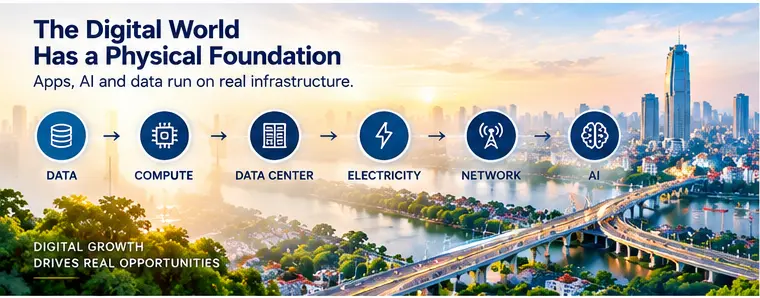
But beneath it lies a physical world:
Data → Compute → Data Center → Electricity → Cooling → Network → Capital
AI requires computing capacity.
Computing capacity requires data centers.
Data centers require electricity, cooling, networks, and capital.
Networks require telecommunications infrastructure.
All of this requires people, land, construction, operations, and supply chains.
Therefore, the digital economy is not entirely “immaterial.”
On the contrary:
The more activities move into digital environments, the greater the demand for certain layers of physical infrastructure may become.
This is the “infrastructure paradox” identified in the architecture of this series: digital development does not make physical infrastructure disappear; in many cases, it increases demand for it.
7. Why Is Digital Transformation Accelerating Now?
Not because of a single technology.
It is happening because multiple technologies have converged.
Internet + Mobile + Cloud + Data + Connectivity + AI + Automation + Digital Infrastructure → NEW DIGITAL CAPABILITIES
When these components come together, businesses can do things that were previously very difficult or expensive:
- process data in near real time;
- serve customers remotely;
- automate parts of a process;
- analyze behavior;
- forecast demand;
- connect multiple systems;
- scale services more rapidly.
The OECD also views the impact of digital technologies and data on existing and new activities as central to digital transformation, while emphasizing that the process affects many sectors, not just the technology industry
8. Digital Transformation Is Not Only for Technology Companies
A bank changes the way customers open accounts.
A hospital builds a patient data system.
A factory connects machines to its management system.
An agricultural company uses data to monitor production.
A school uses a digital platform to manage and deliver services.
A government agency provides services online.
These activities belong to completely different industries.
But they share one common characteristic:
Technology is changing how value is created and delivered.
That is also why Vietnam's National Digital Transformation Program does not limit the discussion to the technology sector. Decision No. 749/QD-TTg sets the objective of fundamentally and comprehensively renewing government management, business production and operations, and the way people live and work, with the goal of moving toward a digital nation by 2030.
9. WHAT PEOPLE OFTEN GET WRONG
5 Common Misconceptions About Digital Transformation
01 — “Having a website means we have gone through digital transformation.”
No.
A website may simply be an information channel.
The more important question is:
Does that website change how the company generates revenue, serves customers, or operates?
02 — “Buying an ERP is digital transformation.”
Not necessarily.
ERP is a tool.
Transformation occurs when that system actually changes how the company manages and operates.
No.
This misunderstanding can have significant consequences.
IT can build or operate the platform.
But transformation involves:
CEO → Operations → Finance → HR → Sales → Customer → Technology
It is a management and strategic issue, not merely an IT issue.
03 — “AI is digital transformation.”
No.
AI is a technology capable of creating major leaps in information processing and automation.
But AI still requires:
Data + Infrastructure + Process + People + Governance.
04 — “The more technology, the better.”
No.
Technology must solve a specific business or social problem.
More technology ≠ more transformation.
05 — “Digital transformation is an IT department project.”
This misunderstanding can have significant consequences.
IT can build or operate the platform.
But transformation involves:
CEO → Operations → Finance → HR → Sales → Customer → Technology
It is a management and strategic issue, not merely an IT issue.
10. WHAT EXPERIENCED PROFESSIONALS LOOK AT
When an expert evaluates a digital transformation program, they usually do not begin by asking:
“What technology is the company using?”
They ask:
1. What problem are we solving?
What problem are we actually trying to solve?
2. What changes in the process?
Which processes genuinely change?
3. What happens to productivity?
Does productivity increase?
4. What happens to decision-making?
Do decisions become faster and more accurate?
5. Can it scale?
Can the model scale, or does it only work at a small level?
This is the difference between technology adoption and business transformation.
11. A Simple Example: From a Traditional Store to a Data-Driven Business
Imagine a retail business.
Previously:
Customers purchase products.
Employees record transactions.
Data sits in notebooks or separate systems.
The business owner relies heavily on experience.
Digitisation stage:
Transactions are entered into software.
Electronic invoices.
Customer information is stored.
Integration stage:
POS connects to CRM.
CRM connects to marketing.
Sales data connects to inventory.
Analytics stage:
The company knows:
- which customers buy what;
- when demand increases;
- which products are trending downward;
- where inventory is located;
- which customers are likely to return.
Transformation stage:
The company begins redesigning:
- product strategy;
- marketing;
- inventory;
- customer service;
- revenue model.
The final outcome is not “the company has software.”
The final outcome is:
The company becomes capable of making decisions and creating value differently from before.
12. What Does a Truly “Digital” Business Need to Change?
It can be viewed through five layers:
| Layer | Question |
| People | Do people have new skills and new ways of working? |
| Process | Have processes been redesigned? |
| Data | Can data be used and connected? |
| Technology | Does technology solve the right problem? |
| Infrastructure | Is the system strong enough to operate and scale? |
If one or more layers are missing, transformation may be constrained.
In particular, infrastructure and integration often become limiting factors once systems begin to scale.
13. The Economic Perspective: Digital Transformation Must Ultimately Create Value
This is a critical point.
Digital transformation should not be measured by:
“How much software has the company purchased?”
It should be evaluated through questions such as:
- Are costs decreasing?
- Does productivity increase?
- Is processing time decreasing?
- Is service quality improving?
- Are customers being served better?
- Are decisions becoming faster?
- Can the business scale without a proportional increase in costs?
- Are there new revenue models?
In other words:
DIGITAL → CAPABILITY → PRODUCTIVITY → COMPETITIVENESS → VALUE
That is why this series does not treat digital transformation simply as a technology story, but places it in relation to productivity, competitiveness, business models, infrastructure, and economic development.
14. What Few People See: Digital Transformation Creates Demand for New Infrastructure
As the digital economy develops, opportunity does not exist only in the applications consumers can see.
Behind a digital service may be:
Connectivity → Data → Data Center → Cloud → Cybersecurity → AI/Software → Integration → Industry Application → Business → Consumer
This is the full digital value chain identified in the architecture of this series.
Therefore, when we talk about:
“The opportunity created by digital transformation”
we should not think only about application startups.
Opportunities may also exist in:
- digital infrastructure;
- data centers;
- cloud;
- cybersecurity;
- data;
- system integration;
- AI infrastructure;
- industry solutions;
- digital services;
- human capital.
This is the layer of opportunity that is often overlooked when people focus only on “apps” or “AI.”
15. Digital Transformation in Vietnam: A Story Bigger Than Technology

Vietnam has elevated digital transformation to the level of a national program.
Decision No. 749/QD-TTg, dated June 3, 2020, approved the National Digital Transformation Program through 2025, with a vision toward 2030. The program identifies three major pillars: Digital Government, Digital Economy, and Digital Society, while placing digital transformation in the context of government operations, businesses, and citizens.
Decision No. 411/QD-TTg, dated March 31, 2022, subsequently approved the National Strategy for the Development of the Digital Economy and Digital Society through 2025, with a Vision toward 2030.
This reveals something important:
Digital transformation in Vietnam is no longer simply a question of whether businesses want to adopt technology. It has become part of the broader story of economic and social development.
But an important distinction must still be made:
A policy direction does not mean that every business or investment opportunity automatically becomes feasible.
Between:
Policy → Market → Investment → Execution
there are still many conditions that must be demonstrated.
That will be the subject of the next articles in this series.
16. WHAT IS OBVIOUS?
Technology is changing the way we work.
That is already obvious.
But:
WHAT IS LESS OBVIOUS?
What is less obvious is:
When the way we work changes at scale, the structure of the economy can also change.
Businesses need new infrastructure.
Workers need new skills.
Industries change.
Business models change.
Capital requirements change.
Even investment structures can change.
Therefore, digital transformation does not create only technology opportunities.
It can create:
infrastructure opportunities + business opportunities + investment opportunities + human-capital opportunities.
17. WHAT WE LEARNED
After the first article, seven key ideas should remain:
1. Digital transformation does not mean buying technology.
2. Digitisation, computerisation, and digital transformation represent different levels.
3. Technology is an enabler, not the entire transformation.
4. Data creates value only when it can be converted into decisions and action.
5. People + Process + Data + Technology + Infrastructure must be viewed as one system.
6. Digital transformation must ultimately create greater capability: higher productivity, better quality, greater speed, scalability, or new value.
7. As digital transformation expands, the story is no longer limited to the technology sector. It increasingly involves infrastructure, capital, energy, human capital, businesses, and national competitiveness.
METAHOME PERSPECTIVE
Technology is only the starting point. Real transformation occurs when technology changes how value is created.
From MetaHome's perspective, what matters is not only which technologies are emerging, but what new demand those technologies are creating for infrastructure, capital, businesses, human capital, and projects that can actually be executed in Vietnam.
Because ultimately, the important question is not:
“What technology do we have?”
It is:
“What can we do better because of that technology?”
WHAT COMES NEXT?
Once we understand what digital transformation is, the next and more important question is:
Why does it matter so much?
From a smartphone, a banking transaction, or an e-commerce order to a factory, a hospital, or an entire economy — what changes is digital transformation creating that we can see, and what changes are still invisible?
That will be the subject of DAY 2:
WHY DOES DIGITAL TRANSFORMATION MATTER?
From a Smartphone to the Entire Economy.