
Understanding the basics to see the investment opportunity behind the carbon market
Carbon credits are becoming a new type of asset linked to the global transition toward a low-carbon economy. To understand the business opportunity, investors first need to understand what a carbon credit is, where it comes from, and why businesses need it.
1. 1. What is a Carbon Credit?
Simply put: One carbon credit represents one metric ton of greenhouse gas emissions reduced or removed from the atmosphere, measured in carbon dioxide equivalent (CO₂e).
The basic process is:
A project reduces emissions → the reduction is measured and verified → carbon credits are issued → the credits can be traded.
For example:
A clean-energy project may reduce 100,000 tons of CO₂e compared with an appropriate baseline scenario.
If the reduction is properly measured, verified and meets the required conditions, the project may generate approximately: 100,000 carbon credits.
he value is therefore not simply in a certificate or document. It comes from the real emissions reduction or removal behind the credit and the ability to demonstrate that result with credibility.
2. How Are Carbon Credits Created?
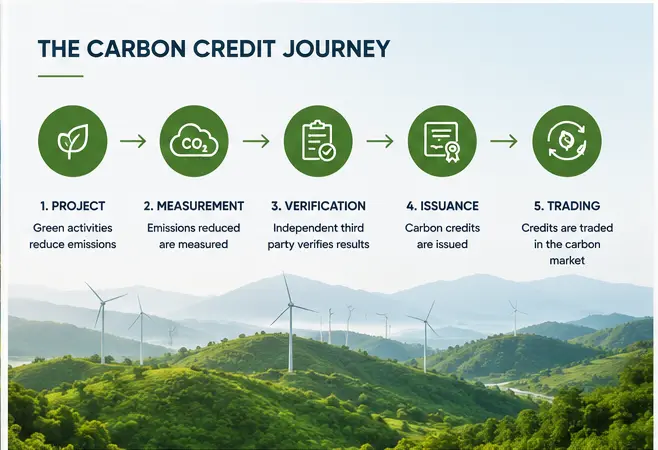
The process can be understood through a simple chain:
PROJECT → EMISSIONS REDUCTION → MEASUREMENT → VERIFICATION → CARBON CREDIT → MARKET
A project can generate carbon credits when it can demonstrate measurable emission reductions or removals against an appropriate baseline scenario.
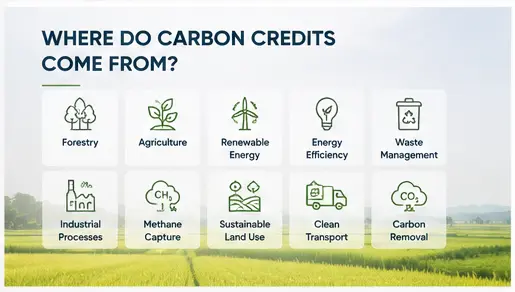
Potential projects can come from many areas:
- 🌱 Agriculture and land use
- 🌳 Forestry and forest restoration
- ☀️ Renewable energy
- ⚡ Energy efficiency
- ♻️ Waste management
- 🏭 Industrial emissions reduction
- 🚛 Transport and logistics
- 💧 Environmental and resource management
- 🌾 Regenerative agriculture
- 🔋 Technologies that reduce emissions
However, not every green project automatically generates carbon credits.
The project must generate emissions reductions that can be measured, demonstrated and verified under an appropriate standard.
3. Why Do Businesses Need Carbon Credits?
This is where investors should pay attention.
The global economy is moving from:
“Produce more”
toward:
“Produce more efficiently with lower emissions.”
More businesses are having to consider emissions from their operations, products and supply chains.
This creates demand for solutions that help businesses:
Measure → Reduce → Manage → Address emissions
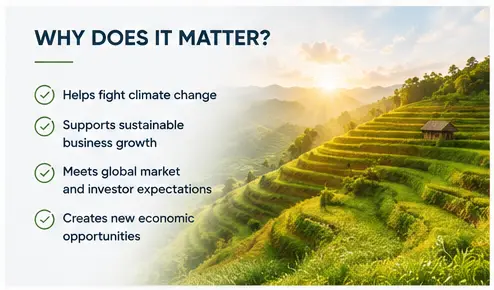
Carbon credits are therefore no longer only an environmental issue.
They are increasingly connected to:
trade • manufacturing • exports • finance • investment • supply chains • competitiveness
4. Why Does Vietnam Have Strong Potential?
Vietnam has a particularly important advantage:
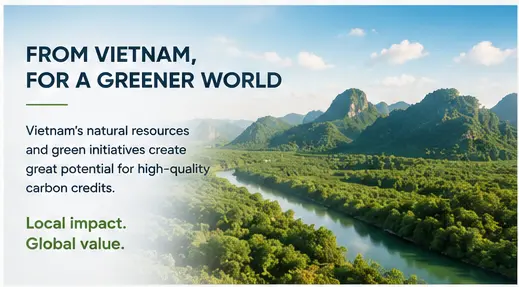
The economy is growing rapidly while also moving toward a lower-carbon development model.
Vietnam has:
- a large manufacturing base;
- a major agricultural sector;
- significant forest resources;
- strong renewable-energy potential;
- expanding industrial and logistics infrastructure;
- growing participation in global supply chains;
- significant demand for investment in green technology and infrastructure.
This creates a fundamental question:
How can emissions reduction be converted into economic value?
This is where the carbon market can create new opportunities.
5. The Opportunity Is More Than Trading Carbon Credits
This is an important point for investors.
If carbon credits are viewed only as a commodity to buy and sell, we are seeing only a small part of the market.
The larger opportunity lies across the entire value chain.
Key opportunity areas include:
1. Project Development
Investing in projects capable of generating measurable emissions reductions
2. Technology
Providing technologies that help businesses reduce emissions.
3. Measurement & Data
Building systems to monitor, manage and demonstrate emissions reductions.
4. Climate Finance
Providing capital for green and low-carbon projects.
5. Carbon Credit Development
Participating in the development, management and commercialization of carbon credits.
6. Market Access
Connecting projects with buyers that need high-quality carbon credits.
7. Business Transformation
Helping businesses move from higher-emission models toward more efficient and lower-carbon operations.
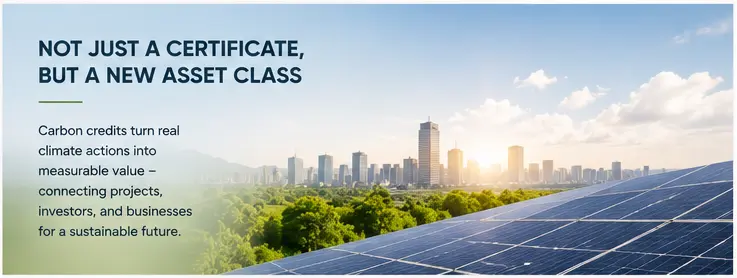
6. How Should Investors Look at Carbon Credits?
Investors should not start with the question:
“How much is one carbon credit worth?”
A more important question is:
“Which projects can generate valuable, verifiable emissions reductions and develop them into commercially viable assets?”
A strong investment opportunity should be assessed across:
Emissions source → Reduction potential → Project scale → Investment cost → Verification potential → Credit quality → Market demand → Revenue potential
This is an investment approach, rather than simply looking at the price of a carbon credit.
7. A Good Carbon Credit Is Not Simply a Cheap Carbon Credit
The future carbon market will increasingly focus on quality.
A carbon credit becomes more valuable when buyers can have confidence that:
- the emissions reduction is real;
- the result can be verified;
- there is no double counting;
- the project creates genuine impact;
- the data is transparent;
- the origin is clear;
- the credit can meet the requirements of its target market.
Therefore:
The greatest opportunity is not simply to create more credits, but to create high-quality credits that have real market demand.
8. Vietnam Is Entering a New Market
Vietnam's carbon market is still developing.
This creates both challenges and opportunities.
The challenge
Regulations, standards, verification mechanisms, trading structures and market operations are still evolving.
The opportunity
Early participants can build:
- capabilities;
- project pipelines;
- data and experience;
- strategic partnerships;
- market knowledge before competition becomes more intense.
In emerging markets, early positioning can become a significant competitive advantage.
9. Where Is the Real Opportunity?
From an investment perspective, the opportunity can be viewed across three layers:
LEVEL 1 — ASSETS
Land • Forests • Agriculture • Energy • Factories • Waste
These are the underlying sources of emissions-reduction potential.
LEVEL 2 — INFRASTRUCTURE
Technology • Data • Measurement • Finance • Project Development
These convert emissions-reduction potential into measurable and verifiable value.
LEVEL 3 — MARKET
Businesses • Investors • Carbon Credit Buyers • International Markets
This is where value can be converted into revenue and cash flow.
The market is created by connecting these three layers.
10. MetaHome's Perspective
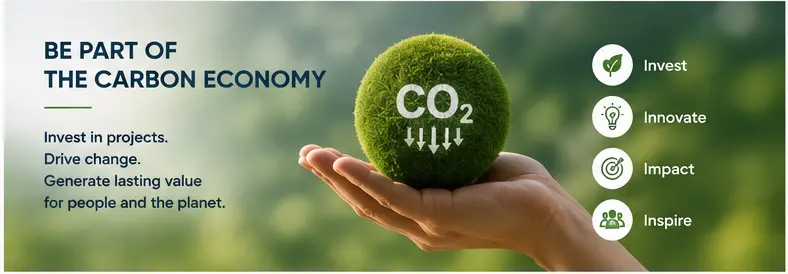
MetaHome does not view the carbon market simply as a market for buying and selling carbon credits.
We see it as an emerging investment ecosystem where capital, technology, projects and market access come together to create economic value from the transition toward a lower-carbon economy.
The important question is not:
“Is carbon a trend?”
It is:
“Which projects can create real value, generate high-quality carbon credits and build sustainable cash flow?”
That is where a serious investment approach begins.