More Capital. More Selective. More Strategic.
The world is not short of capital. What is changing is where capital goes, what it is invested in, and the value it is expected to create.
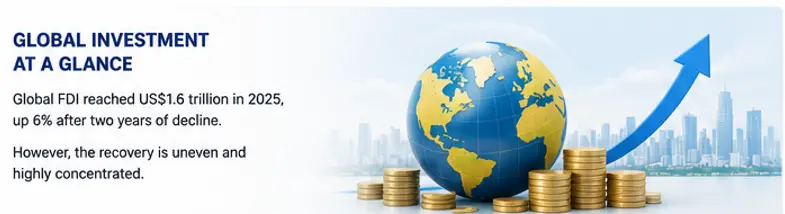
According to the UN Trade and Development (UNCTAD) World Investment Report 2026, global foreign direct investment (FDI) reached approximately US$1.6 trillion in 2025, up 6% after two years of decline.
But the recovery was uneven. For CEOs and investors, this is more than a headline number. It signals a change in the global investment landscape.
1. Global Capital Is Growing — But Not Evenly
FDI into developed economies increased by 11%, while investment into developing economies grew by only 2%, reaching around US$901 billion
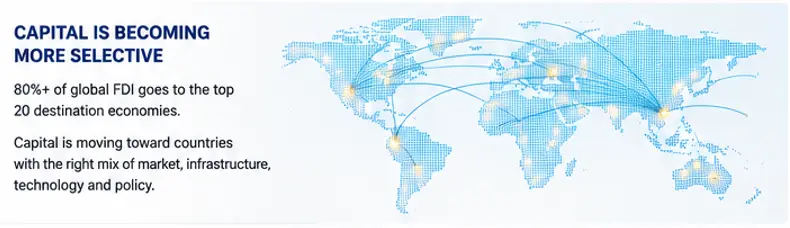
More than 80% of global FDI is concentrated in the 20 largest recipient economies.
This tells us something important:
Capital is no longer moving simply toward markets with high growth potential. It is becoming more selective.
Investors are increasingly looking for the right combination of: Market + Infrastructure + Technology + Policy + Execution
2. Strategic Sectors Are Attracting More Capital
One of the clearest changes is the growing importance of strategic industries.
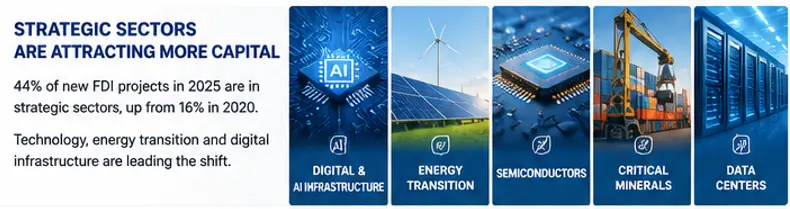
In 2025, strategic sectors accounted for around 44% of the value of new greenfield investment projects, compared with only 16% in 2020.
Capital is increasingly moving toward areas such as:
- Digital and AI infrastructure
- Semiconductors
- Critical minerals
- Energy and the energy transition
- Advanced industrial infrastructure
This is more than a change in investment preferences.
It reflects a broader shift in the global economy:
Capital is looking for capabilities that matter for long-term economic and strategic growth.
3. AI Is Changing the Investment Map
AI is also changing the scale and location of investment.
UNCTAD notes that a significant part of the increase in global FDI in 2025 came from several large-scale projects, particularly digital infrastructure linked to AI.
For major technology and industrial projects, the investment equation is becoming more
It is no longer simply::
Cost → Market → Labour
It increasingly looks like:
Power → Land → Infrastructure → Data → Technology → Talent → Supply Chain → Market
For investors, this means that the quality of the investment location and its ability to support execution are becoming increasingly important.
4. A Bigger FDI Number Does Not Always Mean More Real Investment
This is an important point for investors.
A rise in FDI value does not necessarily mean that the same level of capital is being invested directly into new factories, infrastructure, jobs or technology transfer.
Large transactions, corporate restructuring and financial flows can also affect headline FDI figures.
Therefore, investors should look beyond the total FDI number and ask:
What is this investment actually creating?
The difference is between:
"A country that attracts capital" and "A country that turns capital into new economic capacity.”
5. What Does This Mean for Emerging Economies?
For developing economies, the challenge is no longer simply to attract more FDI.
The bigger question is how investment can create:
Technology
Quality jobs
New skills
Local supply chains
Production capabilities
Long-term value
The development impact of FDI depends heavily on whether investment helps build productive capacity, improve skills and support technology transfer.
This is likely to become an increasingly important measure of FDI quality.
6. MetaHome Perspective: Where Does Vietnam Fit?
From MetaHome's perspective, this global shift raises an important question:
Can Vietnam compete not only for more capital, but for the right kind of capital?
The answer is not simply about investment incentives.
For an international project to succeed, several elements need to work together:
Capital → Technology → Infrastructure → Local Partners → Supply Chain → Market → Policy → Execution
This is where market intelligence becomes an important part of investment decision-making.
7. The Opportunity Is Not Simply Where Capital Goes
For a CEO, the better question is not only:
“Where is the capital?”
It is:
“Where can capital create the greatest long-term value?”
A strong investment destination is not necessarily the place with the largest number of projects.
It may be the place where
capital, technology, infrastructure, resources, markets, partners and policy can work together.
When these elements align, an individual project can become more than an investment.
It can become a long-term growth platform.
MetaHome View
The world is entering a phase where international capital is becoming increasingly selective.
Capital is still growing.
But it is becoming more selective, more strategic and more focused on long-term value.
For Vietnam, this creates both an opportunity and a new form of competition.
The opportunity is to attract investment that brings more than capital:Technology. Management capability. Global supply chains. International markets. Long-term partnerships.
For MetaHome, this is where our role sits:
Connecting global capital with strategic opportunities,
the right partners
and practical execution in Vietnam.
The next phase of global investment will not be defined only by: “Where does capital go?” It will increasingly be defined by:
“What can capital create there?”

References
UN Trade and Development (UNCTAD) — World Investment Report 2026: International Investment in a Turbulent Era, 7/7/2026.
UN Trade and Development (UNCTAD) — Investment in strategic sectors is expanding, but many developing economies risk being left behind, 9/7/2026.