
Healthcare is much more than hospitals.
It is a broad economic ecosystem where health needs, people, technology, pharmaceuticals, medical devices, data, insurance, infrastructure and capital come together to create value.
For investors, the key question is not simply:
“How large is Vietnam’s healthcare demand?”
It is increasingly:
“How is that demand being served? Where are the bottlenecks? Who pays? And where is economic value being created?”
That is the starting point for understanding Vietnam’s healthcare market.
1. What Is Healthcare?
In simple terms, Healthcare covers activities designed to prevent disease, detect health problems, treat illness, support recovery and maintain long-term health.
From an economic perspective, however, Healthcare is much broader.
The healthcare journey can be viewed as:
Prevention → Screening & Consultation → Diagnosis → Treatment → Recovery → Long-term Care
Around this journey is a wider ecosystem:
- Hospitals and clinics
- Pharmaceuticals
- Medical devices
- Diagnostics and laboratories
- Specialized care
- Digital Health
- Health insurance
- Biotechnology
- Healthcare logistics
- Healthcare infrastructure
- Clinical research
- Elderly care
- Home healthcare
Therefore: Healthcare investment does not mean building hospitals.
This is one of the first misconceptions new investors need to avoid.
2. How Does the Healthcare Ecosystem Work?
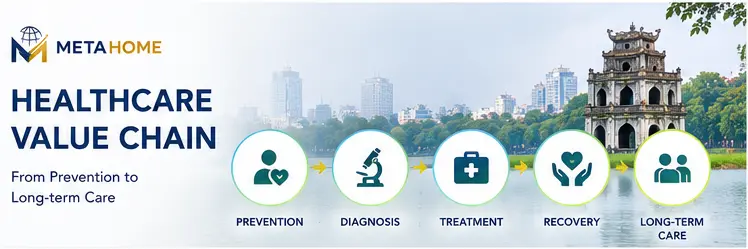
Start with the patient.
A person may move through:
Prevention → Health Check → Screening → Diagnosis → Treatment → Medication/Devices → Recovery → Long-term Monitoring.
Each stage creates its own market.
For example:
Before illness
- Health screening
- Diagnostics
- Nutrition
- Vaccination
- Preventive Healthcare
During diagnosis
- Early detection
- Medical imaging
- Pathology
- Molecular Diagnostics
During treatment
- Hospitals
- Clinics
- Pharmaceuticals
- Medical devices
- Surgery
- Specialized care
After treatment
- Rehabilitation
- Home healthcare
- Chronic disease management
- Long-term Care
The deeper we look into this chain, the clearer it becomes: Healthcare is not one market. It is a network of connected markets.
3. Where Does the Money Come From?
This is one of the most important questions for an investor.
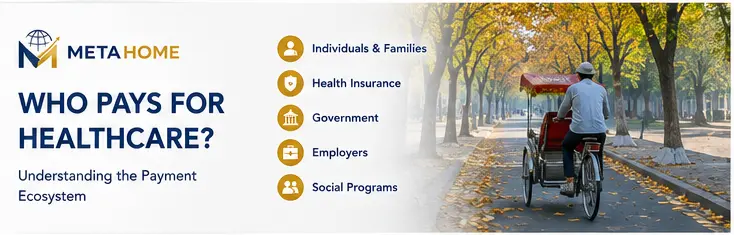
Healthcare services may be paid for by:
- Patients
- Families
- Health insurance
- Commercial insurance
- Employers
- Government
- Social programs
Therefore:
The user is not always the payer.
This distinction is critical when evaluating a healthcare business model.
For example, a patient uses the service but part of the cost may be covered by Health Insurance.
In Vietnam, health insurance is an important part of the healthcare payment system. The amended Law on Health Insurance No. 51/2024/QH15 took effect on July 1, 2025, making reimbursement mechanisms an important consideration for healthcare investors.
A practical investor framework is:
Who uses the service?
Who pays?
How much do they pay?
Under what rules?
These questions help separate healthcare demand from an investable market.
4. How Is Healthcare Different From Other Industries?
Healthcare has an unusually high level of information asymmetry.
Customers often do not have enough information to assess the quality of the service themselves..
Patients often cannot independently assess:
- Whether a treatment is appropriate
- Which diagnostic test is necessary
- Which technology is better
- Which treatment option offers greater value As a result:
Therefore, the healthcare sector has very high information asymmetry.
This leads to an important consequence:
Trust becomes an economic asset.
In many industries, a good brand helps sell products..
Trust becomes an economic asset. In Healthcare, reputation, clinical quality, professional capability and patient confidence can determine whether a business succeeds.
5. Why Is Healthcare Difficult to Enter?
Capital alone is rarely enough.
A healthcare project may require:
Capital
Qualified professionals
Facilities
Medical equipment
Technology
Clinical processes
Licensing
Quality standards
Payment mechanisms
Regulatory compliance
This makes Regulation both a barrier to entry and, potentially, a competitive advantage.
A company that builds strong clinical capability, compliance systems and operational expertise is not easily replaced by a new competitor simply because that competitor has capital.
6. Where Is Vietnam Today?
Vietnam already has a large healthcare system and continues to experience structural changes in healthcare demand.
According to Vietnam’s Ministry of Health, in 2024 the country reached approximately: 14 doctors per 10,000 people 34 hospital beds per 10,000 people 94.1% health insurance coverage
These figures show that:
Vietnam is no longer an early-stage healthcare market.
But a developed healthcare system does not mean every need has been fully addressed.
The next stage is increasingly about:
- Quality
- Resource allocation
- Specialized care
- Technology
- Operational efficiency
- Access to healthcare
- Long-term care
- Pharmaceutical and medical-device capabilities
- Digital transformation
These gaps are where investors should look for market opportunities.
7. Vietnam’s Healthcare Demand Is Changing
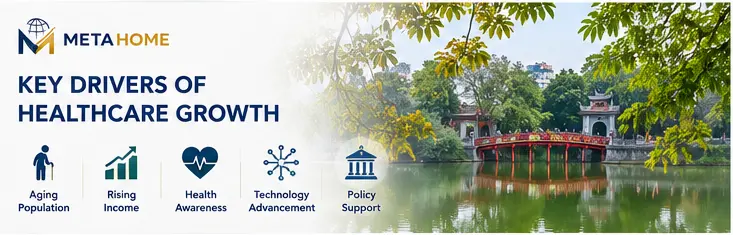
Three structural shifts are particularly important.
1. From Treatment to Prevention
Consumers are increasingly moving toward:
Screening → Early Detection → Prevention
This creates opportunities in:
- Health screening
- Diagnostics
- Early detection
- Preventive care
- Health monitoring
2. From General Care to Specialized Care
The question is no longer simply: “Does Vietnam have enough hospitals?”
It is increasingly:
“What type of hospital, what specialty, what technology and what level of quality?”
Areas such as oncology, cardiology, orthopedics, rehabilitation and chronic disease management deserve close attention.
3. From Hospital-centered to Distributed Healthcare
The future healthcare model may increasingly combine:
Hospital + Clinic + Home Care + Digital Health + Remote Monitoring
Patients will not necessarily need to visit a hospital for every healthcare need.
That creates opportunities for new business models.
8. A Common Mistake: “A Large Market Means a Good Investment”
Not necessarily.
A healthcare market can have huge demand and still produce poor investment returns.
Experienced investors move through the following chain:
Demand → Market → Revenue → Margin → Cash Flow → Return on Capital
For example:
A service may have millions of potential users but still be unattractive if:
- Pricing is low,
- Operating costs are high,
- Capital requirements are heavy,
- Payback takes too long,
- Skilled professionals are difficult to find
Conversely,
a smaller market with:
- strong pricing power,
- clear customers,
- valuation ability,
- good margins,
- scalability,
may be more attractive.
Therefore:
Do not simply look for large demand. Look for a meaningful gap between demand and efficient supply.
9. Where Are the Healthcare Market Gaps?
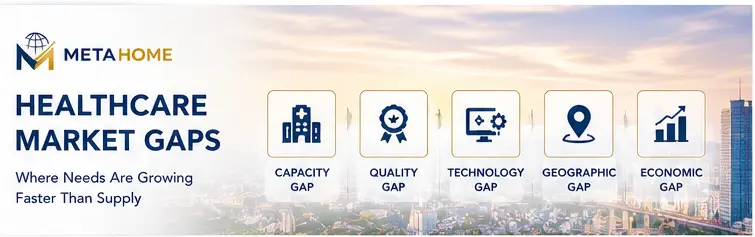
Five types of gaps are particularly useful when screening opportunities.
1. Capacity Gap
Not enough capacity to meet demand.
2. Quality Gap
Services exist, but quality is inconsistent.
3. Technology Gap
Demand exists, but technology is not sufficiently available or adopted.
4. Geographic Gap
Healthcare capacity is concentrated in major centers while other areas remain underserved.
5. Economic Gap
Services exist but remain difficult to access because of cost or affordability.
This is the type of market map an investor should build.
10. Understanding Vietnam’s Healthcare Regulatory Environment
Healthcare is a highly regulated industry.
Vietnam’s Law on Medical Examination and Treatment No. 15/2023/QH15 took effect on January 1, 2024, together with Decree 96/2023/ND-CP,
creating an important legal framework for medical examination and treatment.
For pharmaceuticals, Law No. 44/2024/QH15, amending the Law on Pharmacy, took effect on July 1, 2025.
Medical devices are governed by a regulatory framework covering areas such as:
- Classification
- Clinical requirements
- Market Circulation
- Buying and selling
- Import and distribution
- Advertising
- Pricing
- Use in healthcare facilities
The main foundation is Decree 98/2021/ND-CP and the amended and supplemented documents; the Ministry of Health has published a consolidated document and the system of regulations continues to be updated, including Decree 04/2025/ND-CP..
The key point is:
Regulation should not be treated as a checklist of licenses.
It should be considered when designing the business model itself.
11. How Should an Investor Approach Healthcare?
A practical investment process can be simplified into seven steps:
01 — Identify the Need
What problem actually needs to be solved?
02 — Map the Value Chain
Where does that need sit within Healthcare?
03 — Find the Gap
What is currently underserved?
04 — Check Regulation
Is the business legally permitted, and under what conditions?
05 — Test the Economics
Who pays? What is the price? What are the costs and margins?
06 — Build the Operating Model
What people, technology, equipment and infrastructure are required?
07 — Scale
Can the model be replicated across locations or markets?
This is a stronger approach than starting with:
“I have capital. Find me a hospital project.”
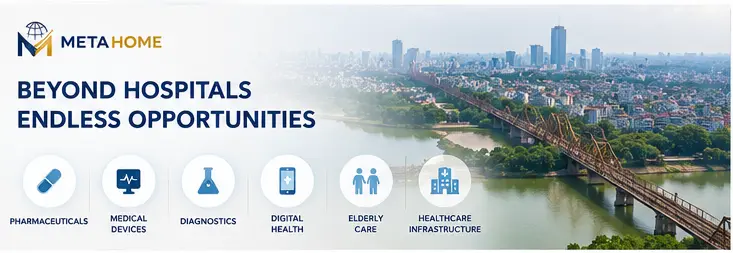
12. Where Could Business Opportunities Emerge?
Healthcare opportunities extend well beyond hospitals.
Can be studied:
Healthcare Services
- Hospitals
- Clinics
- Specialized care
- Rehabilitation
Diagnostics
- Early detection
- Medical imaging
- Molecular Diagnostics
- Screening
Pharmaceutical
- Manufacturing
- Generic
- Specialty Drugs
- Biosimilar
- Vaccination
Medical Devices
- Diagnostic equipment
- Treatment equipment
- Medical consumables
- Monitoring devices
Digital Health
- Electronic medical records
- AI
- Telemedicine
- Remote Monitoring
Elderly & Long-term Care
- Elderly care
- Nursing Care
- Home Healthcare
- Rehabilitation
Healthcare Infrastructure
- Hospitals
- Diagnostic centers
- Clinics
- Laboratories
- Pharmaceutical facilities
- Healthcare logistics
This is where Healthcare begins to intersect with: Real Estate + Technology + Manufacturing + Logistics + Finance
13. An Advanced View: Healthcare Is More Than a Service Industry
This is one of the most important investment perspectives.
Healthcare can simultaneously be viewed as:
Service Industry
Technology Industry
Manufacturing Industry
Infrastructure Industry
Data Industry
Financial Ecosystem
Therefore, experienced investors do not simply ask:
“Should I invest in Healthcare?”
They ask:
“Where do I have an advantage within the Healthcare value chain?”
For example:
- Capital → Healthcare Investment
- Technology → Digital Health
- Manufacturing → Pharmaceuticals / Medical Devices
- Real Estate → Healthcare Infrastructure
- Logistics → Medical Supply Chain
- Data → Health Data / AI
- Operations → Healthcare Services
The opportunity depends not only on the market, but also on the investor's own capabilities.
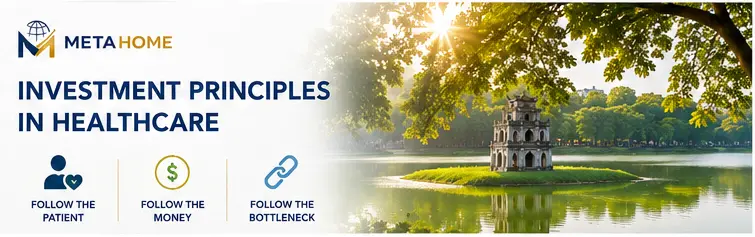
14. THREE PRINCIPLES FOR HEALTHCARE INVESTORS
1. Follow the Patient
Do not start with the product.
Start with the:
Patient Journey
What problem does the patient face?
At what stage?
Who currently solves it?
How effectively?
2. Follow the Money
Always ask:
Who pays?
A good product can still fail if the payment or reimbursement model does not work.
3. Follow the Bottleneck
Do not only look for large markets.
Look for:
Bottlenecks that the market must eventually solve.
These may include:
- Shortage of specialists
- Lack of advanced diagnostics
- Missing equipment
- Limited technology
- Insufficient facilities
- Manufacturing gaps
- Data limitations
- New models of care
Where the bottleneck is significant enough, there may be an investable opportunity.
15. Where Is Vietnam’s Healthcare Market Heading?
The broader picture can be summarized as:
Nhu cầu đang tăng + hệ thống đã có nền tảng + công nghệ đang thay đổi + mô hình tiêu dùng đang thay đổi + khoảng trống vẫn tồn tại = nhiều không gian cho đầu tư.
But:
Opportunity ≠ Easy Money.
Healthcare also involves:
- High regulatory requirements
- Significant capital needs in some segments
- Specialized talent
- Complex operations
- Long development cycles
- Potentially long capital recovery periods
The advantage is that businesses combining clinical capability, technology, trusted brands, strong operations and regulatory compliance can build meaningful barriers to entry.
CONCLUSION

Healthcare is not a single market.
It is an ecosystem spanning:
Prevention → Diagnosis → Treatment → Recovery → Long-term Care
supported by:
Pharmaceuticals → Medical Devices → Diagnostics → Technology → Data → Insurance → Infrastructure
For Vietnam, the opportunity is not simply the size of healthcare demand. It is the gap between growing demand and the ability of the existing system to meet that demand efficiently, affordably and at the required quality.
For investors, the real question is therefore not:
“Should I invest in Healthcare?”
It is:
“Which part of the Healthcare value chain has growing demand, insufficient supply, a viable business model and a clear fit with my capabilities?”
That is where a genuine Investment Thesis begins.
METAHome Investment Perspective
The best healthcare opportunities may not be where the market is largest. They may be where demand is growing faster than the ability to serve it.
When Healthcare is viewed through this lens, investors see more than hospitals
They see opportunities across healthcare services, diagnostics, pharmaceuticals, medical devices, Digital Health, elderly care, infrastructure, data and the new gaps emerging across the ecosystem.
Understanding the Market. Identifying the Gaps. Finding the Opportunities.