
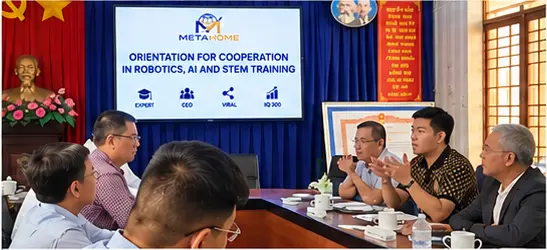
On 13 May 2026, MetaHome participated in a working session at Bach Nghe Vocational School of Ho Chi Minh City to discuss potential cooperation, advisory support, and implementation of programs related to Robotics, Artificial Intelligence (AI), and STEM in the vocational education environment.
The working session focused on connecting technology with practical training, while also discussing models that could be suitable for the school’s direction of developing technical and technological capabilities among learners.
From Vocational Training to Technology Capability
Bach Nghe Vocational School of Ho Chi Minh City is a vocational education institution that trains economic and technical human resources for Ho Chi Minh City and surrounding areas. The school currently offers a range of technical disciplines, including Control and Automation Engineering Technology, Mechanical Engineering, Electronics and Telecommunications, Industrial and Civil Electricity, Applied Informatics, and related fields.
This also provides a relevant context for considering Robotics, AI, and STEM: as technology becomes increasingly integrated into manufacturing, automation, and services, vocational education needs not only to provide foundational knowledge but also to create opportunities for learners to observe, program, design, control, and solve problems through technology.
During the working session, the parties discussed the possibility of introducing these areas into the training environment through models suited to the school’s actual conditions.
Robotics, AI and STEM: More Than Equipment
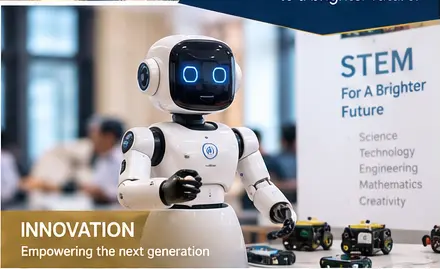
One notable topic discussed during the session was the approach to AI Education and Robotics Education.
According to the professional materials used during the discussion, the programs can combine multiple components such as Robot Class, Programming Class, Physical Design, Intelligent Control, AI Algorithm, and Maker/STEM, thereby developing learners’ observation, logical thinking, programming, design, and creative capabilities simultaneously.
This shows that Robotics in education is not simply about bringing a robot into the classroom.
The greater value lies in the training ecosystem behind the equipment:
Equipment → Curriculum → Teachers → Practice → Projects → Competency Assessment.
This is also why AI Labs, STEM Labs, and teacher training programs are receiving growing attention across various education systems.
The materials discussed during the working session also referred to an ecosystem comprising curricula, teaching tools, teacher training, practical learning, competitions, and certification; while emphasizing international orientation, systematic development, and adaptability to the Vietnamese education context.
From the Classroom to the Practical Training Lab
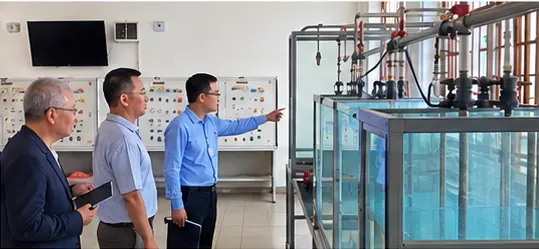
Following the discussion, the working delegation surveyed several practical training spaces and technical facilities at the school.
The images from the working session show that the activity went beyond theoretical discussion. Directly observing the practical training facilities provided the parties with additional grounds to consider possible connections between existing training infrastructure and new technology programs.
This is an important consideration for Robotics and STEM programs.
An effective training model needs to be designed around the actual conditions of each institution, including space, equipment, teaching staff, learner proficiency, training programs, and intended learning outcomes.
Why Are Robotics and AI Relevant to Vocational Education?
The development of automation is changing the requirements for the technical workforce.
In Vietnam’s industrial development direction, the need is not only to expand production capacity but also to strengthen automation, industrial robotics, smart manufacturing, energy-efficient technologies, and research and development capabilities.
At the policy level, Vietnam has also issued the National Strategy for Research, Development and Application of Artificial Intelligence through 2030 under Decision 127/QĐ-TTg in 2021.
In education, the Ministry of Education and Training has also emphasized improving workforce quality in connection with science, technology, and innovation, while promoting training in areas such as AI, data science, semiconductors, and emerging technologies.
Therefore, the role of Robotics and STEM in vocational schools can be viewed from a broader perspective:
Technology education today is preparation for the production systems of tomorrow.
How Is MetaHome Involved?
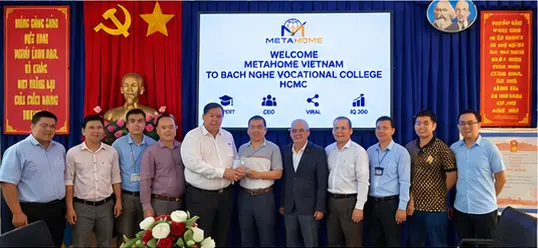
In the 13 May activity, MetaHome focused on its role in connecting, discussing, and supporting the exploration of potential cooperation among relevant parties.
The areas of interest included:
- The potential application of Robotics and AI in training;
- STEM/Maker models suitable for the vocational education environment;
- The potential development of technology practice spaces or laboratories;
- Connecting training programs with practical skills requirements;
- Discussing advisory and implementation options based on the school’s specific conditions;
- The potential coordination with technology and training partners in subsequent steps.
The important point is that this activity should currently be understood as a step toward discussion and exploration of potential cooperation, rather than an announcement of an officially implemented program.
A Small Connection Within a Larger Need
Robotics, AI, and STEM are often discussed as technologies of the future. But for vocational education, the more practical question is:
Who will operate those technologies?
A smart factory needs technicians.
A robotic system needs people who can program, operate, and maintain it.
An automated production line needs engineers and technical personnel capable of working with control systems.
And before these people enter the workforce, they need exposure to technology within the training environment.
This is why the connection between schools – businesses – technology is becoming increasingly important.
Next Steps
The parties will continue discussions and explore the conditions required for potential cooperation in Robotics, AI, STEM, and technology training.
For MetaHome, the next step is not simply to introduce a technology into an educational institution, but to seek a model that can fit actual needs, develop people’s capabilities, and move toward long-term implementation.
MetaHome Perspective
MetaHome views technology education not only as an area of training, but also as part of the human capital infrastructure for a high-tech economy.
From technology connection → program development → capability building → toward practical implementation, small activities today can become a foundation for larger projects in the future
Develop opportunity. Connect resources. Toward execution.