
Investment Thesis: Education could become a long-term investment market in Vietnam not simply because there are many learners, but because the economy is changing faster than the market’s ability to supply the skills it needs. As a result, value is shifting from “selling places to study” toward building human capital infrastructure for industry, technology, and emerging economic sectors.
This is also the core logic behind MetaHome’s series: rather than viewing education simply as schools, we need to look more broadly at Human Capital, Skills, Productivity, Innovation, and the ability to meet the needs of the economy.
1. THE REAL ISSUE: THE ECONOMY MAY BE CHANGING FASTER THAN THE EDUCATION SYSTEM
Investors often start with questions such as: How many students does Vietnam have? How much are tuition fees? Is there still room for private schools?
These are necessary questions, but they do not address the most important issue.
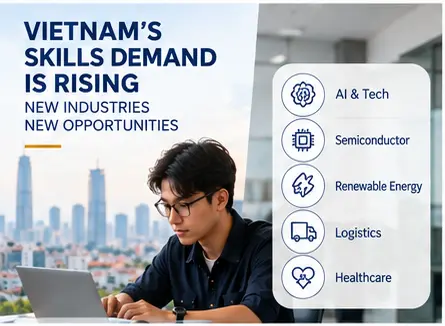
A semiconductor factory needs more than land and power. It needs engineers.
A Data Center needs more than servers. It needs people capable of operating power systems, cooling systems, cybersecurity, and infrastructure management.
A modern logistics network needs more than manual labor: it needs supply-chain management, automation, data, and operational skills.
When the pace at which new skills are demanded exceeds the pace of training, that gap becomes a market.
This is why investors should pay attention to education investment in Vietnam now.
2. UNDERSTANDING THE CORE: EDUCATION IS NOT ONLY ABOUT DEGREES
From an economic perspective, the final product of education is not a degree.
It is:
human capability → productivity → employability → business capability → economic competitiveness.
What many people often misunderstand is:
Education demand = the number of students.
In reality, demand also comes from people who are already working but need to reskill, upgrade their capabilities, or change careers.
Technology changes. Businesses change. Professional standards change.
Therefore, Learning Demand does not end when a person graduates. This is one of the reasons education and training have a longer-term nature than many conventional consumer industries.

3. WHAT REALLY CREATES VALUE IN THE EDUCATION MARKET?
Not every education segment is equally attractive. Investors need to look at at least four factors.
1. The Skills Gap
Real demand emerges when businesses need a type of talent that the market does not yet provide in sufficient quantity, quality, or practical capability.
This Demand–Supply Gap matters much more than simply identifying an industry that is “hot.”
2. Ability to Pay
Demand does not automatically mean there is a market.
The payer may be:
- parents;
- learners;
- businesses;
- organizations;
- or another training partnership structure.
Investors need to identify who actually pays and why they continue to pay.
3. Asset Utilization
A beautiful campus with empty classrooms is an inefficient asset.
For CAPEX-intensive models, the utilization rate of facilities, enrollment scale, and time required to reach break-even can be more important than the listed tuition fee.
4. Scalability
A good school is not necessarily a good investment platform.
More attractive models tend to have the ability to:
standardize programs → reuse technology → expand locations → build a brand → reduce cost per learner.
4. WHERE IS VIETNAM’S EDUCATION MARKET TODAY?
The important point is not that Vietnam “lacks education.”
Vietnam already has a large-scale education system.
The investment question is whether the structure of supply can keep pace with the changing structure of demand.
Vietnam’s education development strategy toward 2030, with a vision to 2045, sets a target for STEM disciplines to account for 35% of higher education training, while also emphasizing AI, data science, semiconductors, the digital economy, the green economy, and high-quality human resources.
This is an important signal.
Fact: The direction of training is shifting toward science, engineering, and technology.
Interpretation: The structure of workforce demand in the economy is changing.
Investment implication: Value may emerge in specialized, technical, and industry-linked training models — not necessarily only in traditional schools or universities.
This is also why areas such as vocational training, corporate training, AI, semiconductor, engineering, logistics, energy, and healthcare training deserve attention.
5. POLICY & MARKET CONDITIONS: WHAT SHOULD INVESTORS KNOW BEFORE ENTERING?
Education is not an industry that can be approached through a simple logic:
capital → premises → teachers → enrollment → operations.
Depending on the model, a project may involve requirements relating to establishment, facilities, programs, personnel, quality, operating approvals, and investment.
Notably, Law on Higher Education No. 125/2025/QH15 and Law on Vocational Education No. 124/2025/QH15 both took effect on January 1, 2026.
For foreign investment and cooperation, Decree 86/2018/ND-CP remains an important part of the legal framework and was amended by Decree 124/2024/ND-CP, effective from November 20, 2024.
The point investors should remember is:
Legal feasibility is not a final-stage check. It must be built into the Business Model from the beginning.
A model can be highly attractive from a market perspective and still fail to launch if its legal structure, location, programs, or operating conditions are not suitable.

6. THE INVESTMENT LENS — WHERE DO MONEY AND VALUE REALLY SIT?
This is the most important part.
New investors often look at:
tuition fee × number of learners.
Experienced investors look deeper:
Demand × Retention × Utilization × Pricing Power × Cost Structure × Scalability.
A project with 1,000 learners is not automatically better than one with 500 learners.
Value depends on retention, program quality, brand reputation, asset utilization, student acquisition costs, and scalability.
The opportunity does not necessarily sit in the school itself.
It may sit behind the school:
Infrastructure — campuses, labs, student housing, and equipment.
Technology — LMS, AI tutors, assessment, and learning analytics.
Services — enrollment, certification, and corporate training.
Specialized Training — technical, technology, aviation, healthcare, and logistics training. .
Ecosystem — connecting schools, businesses, technology, and employment.
This is an important shift in perspective.
Education can become an attractive investment sector when investors identify the right value-creation point in the chain, rather than assuming they must own a school.

7. OPPORTUNITY MAP — 5 AREAS WHERE OPPORTUNITIES COULD EMERGE
| Opportunity | Why now? | Who can participate? | Key requirement | Main risk |
| Technical & Vocational Training Skills | demand is changing with industry and technology | Vocational schools, industrial companies, education investors | Programs must match recruitment demand | Training does not match employment |
| Corporate Training | Businesses must continuously upgrade workforce skills | Training companies, FDI businesses, technology platforms | Real corporate customers | Long sales cycles |
| AI & EdTech | Technology is changing how people learn and how learning is assessed | Startups, technology firms, education groups | Retention + content + revenue model | Technology is easy to replicate |
| International Education & Partnerships | Demand for international education standards and integration | Schools, universities, international education groups | Legal framework + programs + brand | High operating costs |
| Education | Infrastructure Some models require campuses, labs, housing, and specialized technology | Developers, infrastructure funds, schools, operators | Clear off-take/user demand and operator | High CAPEX, low utilization |
In early childhood education, the national strategy targets the share of non-public and private facilities to reach 30% by 2030, while the share of children enrolled is targeted at 35%, indicating that the non-public sector continues to be viewed as a component of education supply.

8. WHAT DO EXPERIENCED PLAYERS ACTUALLY WATCH?
1. Utilization before revenue
A campus creates value only when it is used efficiently.
2,000 places with only 700 learners can be more concerning than a high tuition fee.
2. Retention before Enrollment
Attracting learners is one thing.
Keeping them, encouraging continued learning, and generating referrals are stronger indicators of the model’s quality.
3. Employer Off-take in vocational training
Technical training is strongest when actual recruitment demand sits behind the program.
A center with direct links to employers can have an advantage over a center that simply “predicts” what the market needs.
4. CAPEX per student
Do not only ask how attractive the school is.
Ask:
How much capital is required for each learning place, and how long will it take to utilize that capacity effectively?
5. Execution capability
In education, brands and programs can be acquired or developed through partnerships.
But building a teaching team, maintaining stable enrollment, controlling quality, and operating consistently for years are capabilities that are harder to replicate.
That is where a real moat can emerge.
9. THREE THINGS TO REMEMBER
First: The long-term market does not come simply from the fact that Vietnam has many learners. It comes from the economy’s continuing need to upgrade its human capital.
Second: Value does not necessarily sit in schools. It can sit in specialized training, technology, infrastructure, services, and the connection between education and employment.
Third: A strong education project must demonstrate demand, unit economics, and legal feasibility at the same time. If one of the three is missing, even a large market may not be enough to create a good investment.
MetaHome View
The next phase of Vietnam’s education sector may not be determined by the number of new schools, but by the ability to close the gap between the skills the economy needs and the capabilities the education system can provide. 
The long-term opportunity is not simply in selling education
It is in building the human-capital infrastructure behind Vietnam’s next economic cycle.