
A Data Center can require hundreds of millions of USD to build. But scale alone does not make an investment attractive.
The Investment Thesis of this article is simple:
The value of a Data Center does not lie in the number of MW announced. It lies in the ability to turn those MW into capacity with customers, operate it reliably, and generate cash flow at a reasonable cost of capital.
This is also the core logic of MetaHome’s second article in the Data Center series: shifting the perspective from Technology to Investment, and from “how many MW can be built” to “how much economic value each MW can create.
1. A Large Data Center Is Not Necessarily a Good Investment
From the outside, Data Centers can easily impress investors with big numbers:
50 MW. 100 MW. 200 MW. Hundreds of millions of USD in CAPEX.
But investors are not rewarded simply because a project is “large.”
They earn returns when that capacity is sold or leased, customers stay long enough, operating costs are controlled, and the asset can be expanded or refinanced.
A project with a 100 MW design but only 40 MW contracted has completely different economics from a 100 MW project where most of the capacity has already been committed by customers.
This is the distinction between installed capacity and revenue-generating capacity.
Therefore, the first question should not be:
“How many MW does this Data Center have?”
It should be:
“How much of that capacity can generate revenue, for whom, under what terms, and how much capital is required to create it?”
2. How Does a Data Center Actually Make Money?
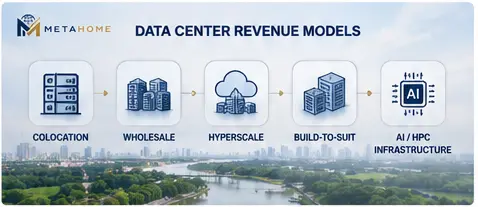
At its core, a Data Center sells high-reliability digital infrastructure capacity.
Customers may include banks, large enterprises, telecom operators, cloud providers, hyperscalers, digital platforms, or AI businesses.
Common revenue models include:
- Colocation: multiple customers lease racks or smaller amounts of capacity.
- Wholesale: customers lease large amounts of capacity.
- Hyperscale: infrastructure designed for very large cloud and technology customers.
- Build-to-Suit: a facility developed according to the requirements of an identified customer.
- AI/HPC: infrastructure serving AI and high-performance computing applications.
The important point is not to memorize the names of these models.
The important point is to understand that the certainty of demand varies, and therefore the level of risk varies.
A Build-to-Suit project with an anchor customer secured early is fundamentally different from building tens of MW in advance and expecting the market to absorb them later.
3. What Really Determines Data Center Economics?
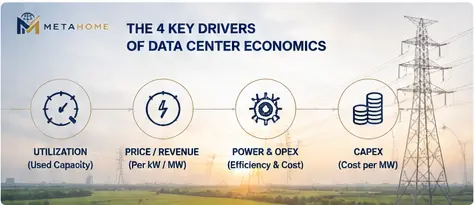
The investment equation can be reduced to four variables.
1. Customer-Utilized Capacity
This is utilization.
An asset with large capacity but low utilization has a significant amount of capital tied up in infrastructure that is not yet generating revenue.
2. Capacity Pricing
What customers pay for rack space, kW, or MW depends on the market, asset quality, reliability, connectivity, power density, and contract structure.
3. Power and Operating Costs
Electricity is one of the most important operating cost components.
Therefore, operational efficiency cannot be assessed through a single technical metric alone. PUE becomes economically meaningful only when considered together with electricity prices, utilization, and IT Load.
4. Capital Invested per MW
Land, power infrastructure, substations, buildings, cooling, UPS, generators, network infrastructure, and backup systems all require capital before revenue begins.
This is why an industry can be growing rapidly while a specific project can still generate a low return.
4. Where Does Vietnam Stand in This Equation?
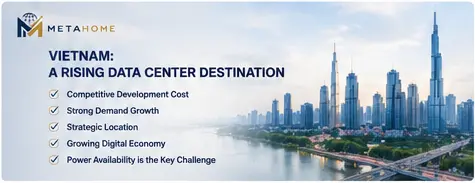
This is what makes the Vietnamese market particularly interesting.
According to Cushman & Wakefield, Data Center construction costs in Vietnam in 2026 are estimated at approximately USD 5.7–8.7 million per MW, with a midpoint of around USD 7.2 million per MW. Vietnam therefore sits among the more cost-competitive Data Center development markets in Asia-Pacific.
The same source records approximately 73 MW of operational capacity and an additional 137 MW in the pipeline through 2030 within the market scope covered by its report. But there is an even more important data point: in the major clusters, securing additional power for a project of around 100 MW can take 2–3 years.
This is a clear example of how investors should read market data:
Fact: Vietnam’s development costs are relatively competitive.
Interpretation: Interpretation: Entry costs may be more attractive than in many mature markets.
Investment implication: This does not mean every project will be easy to develop, because power availability and the timeline for securing electricity can become critical constraints on actual development speed.
At the regional level, APAC had 26.5 GW of Data Center development pipeline in the first half of 2026, while colocation vacancy declined from 10.9% to 10.3%. Southeast Asia accounted for approximately half of the region’s construction pipeline.
This indicates that capital is flowing strongly into the sector — but it also raises the competitive standards for Vietnam.
5. Conditions for Market Entry in Vietnam Have Changed Significantly
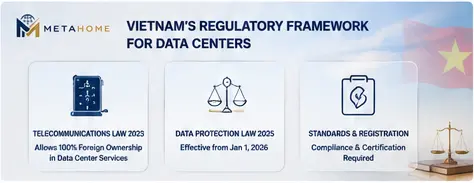
One important change is Vietnam’s Law on Telecommunications 2023, which came into effect on 1 July 2024 and formally brought Data Center and cloud computing services into the telecommunications regulatory framework.
Notably, Article 29 allows investment in Data Center and cloud computing services without limiting the foreign ownership ratio of shares or contributed capital.
However, service providers must comply with registration or notification requirements, and before making a Data Center available to the public, they must publish its conformity with applicable technical standards and regulations.
Vietnam’s Law on Personal Data Protection No. 91/2025/QH15 also took effect on 1 January 2026, together with Decree No. 356/2025/ND-CP guiding its implementation. .
For investors, the implication is not that they need to become legal experts.
The implication is:
A Data Center must be underwritten simultaneously as a real estate asset, an energy project, a technology infrastructure asset, and a business subject to data-related obligations.
6. The Investment Lens: Where Does the Money Really Come From?
This is the most important section.
New investors tend to look at the building and the servers.
Experienced investors look at who controls scarce inputs and who can sell the capacity.
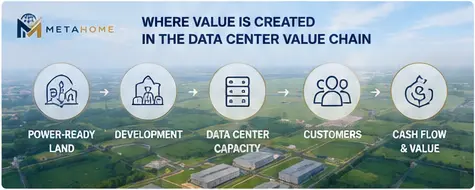
The value chain can be understood simply as:
Power-ready Land → Development → Data Center Capacity → Customers → Cash Flow
Within that chain, value can be created at multiple points.
Power-ready site
An ordinary piece of land may not be particularly special.
But a site with suitable zoning, access to large-scale power capacity, strong fiber connectivity, and the ability to be developed quickly is a completely different asset.
Contracted capacity
Contracted Capacity One MW backed by a long-term customer contract has very different economics from one MW that exists only in a business plan.
Platform
Platform A developer capable of repeatedly identifying sites, securing power, obtaining permits, building facilities, and attracting customers across multiple locations can create a stronger moat than simply owning a single Data Center.
Infrastructure around the Data Center
The opportunity does not necessarily lie inside the Data Center.
It may lie in:
grid connection, substation, renewable power, BESS, fiber, cooling, equipment, engineering hoặc financing.
The MetaHome series framework also identifies opportunities through land, power, fiber, cooling technology, equipment, financing, or a development platform, without necessarily becoming a Data Center Operator.
7. Opportunity Map — What Opportunities Could Emerge in Vietnam?
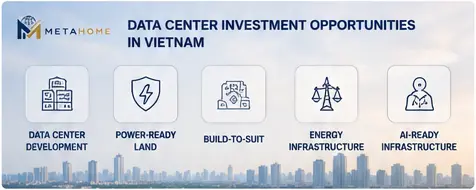
| Opportunity | Why now | Ai có thể tham gia | Điều kiện quyết định | Rủi ro chính |
| Data Center Development | Growing demand for cloud, AI and digital infrastructureNhu cầu cloud, AI và digital infrastructure tăng | Developer, infrastructure fund, operator | Power + customer + site | Building ahead of demand |
| Power-ready Land | Land Power is becoming a scarce resource | Landowner, industrial developer, fund | Actual grid access | Power exists “on paper” only |
| Build-to-Suit | Reduces demand risk | Developer + anchor customer | Long-term contract | Customer concentration |
| Energy Infrastructure | Data Centers require large and reliable power supply | Utility, energy investor, BESS developer | Connection + economics | Regulation, CAPEX |
| AI-ready Infrastructure | AI is increasing power density and cooling requirements | Technology, DC operator, specialist developer | Customer + technology maturity | Technology obsolescence |
AI is changing the underlying cost structure itself.
Cushman & Wakefield notes that AI-ready Data Centers require higher power density, more sophisticated cooling, and stronger structural requirements, meaning their CAPEX model must be assessed differently from traditional Data Centers.
8. What Do Experienced Investors Actually Watch?

There are five questions that matter more than headlines about “project scale.”
1. How much MW is contracted?
Not how much MW has been announced.
2. Is power actually available?
Not simply whether documents indicate that power could be supplied.
3. What is CAPEX per MW?
And more importantly: how much EBITDA can each MW generate?
4. Who are the customers and how long are the contracts?
Customer credit quality can directly affect debt financing capacity and asset valuation.
5. Can the project scale?
A 20 MW site with a pathway to 80 MW can have very different strategic value from a site that has nearly exhausted its infrastructure capacity.
One notable benchmark: Cushman & Wakefield’s 2025 research estimated Vietnam Data Center yield-on-cost at approximately 17.5–18.8%, the second-highest among the APAC markets surveyed at that time. This is a market benchmark, not a guaranteed return for any specific project.
The difference between those two numbers is execution.
9. If You Remember Only Three Things
First: MW is not revenue. Contracted and utilized MW is what begins to create the economics.
Second: Low construction costs are only an advantage if the project also has power, customers, and the ability to execute at the right time.
Third: The most attractive opportunity does not necessarily lie in owning a completed Data Center. It may lie in power-ready land, energy infrastructure, fiber, cooling, Build-to-Suit, or a development platform.
In Vietnam’s next Data Center cycle, the most valuable asset may not be the largest building — but the asset that controls what the market lacks most.
And for Data Centers, those increasingly are power, customers, and execution capability.